

We source fresh against confirmed orders. We do not hold standing NESCAFÉ inventory. Sourcing offers depend on the product, label, quantity, and destination, and fresh sourcing does not promise a particular production date.
Select a format below to navigate directly to technical specifications, case hierarchies, and trade configurations:
Classic Retail Jars
Designed for mainstream supermarket shelves and high-turnover grocery lines requiring standard retail glass packaging.
Gold Premium Jars
Suited for premium retail positioning, featuring distinct freeze-dried coffee blends and specialized glass container designs.
3-in-1 Sachets
Formulated as pre-portioned coffee mixes blending soluble coffee, creamer, and sugar for convenience retail and hospitality.
A plain instant coffee stick and a 3-in-1 coffee mix sachet represent entirely different orders even though both feature single-serve presentation. Plain sticks contain 100 percent pure soluble coffee granules, whereas 3-in-1 sachets combine soluble coffee with creamer and sugar formulations designed for quick reconstitution.
NESCAFÉ Classic: Glass Jars, Refills, and the Six-Jar Case
Retail grocers and institutional catering buyers select NESCAFÉ Classic wholesale lines for dependable mass-market appeal. Glass jars are commonly packed six units per corrugated shrink-wrapped tray, whereas refill pouches ship in high-density cases designed to conserve freight volume. Sourcing teams must specify the exact container format and net grammage to avoid packaging discrepancies.
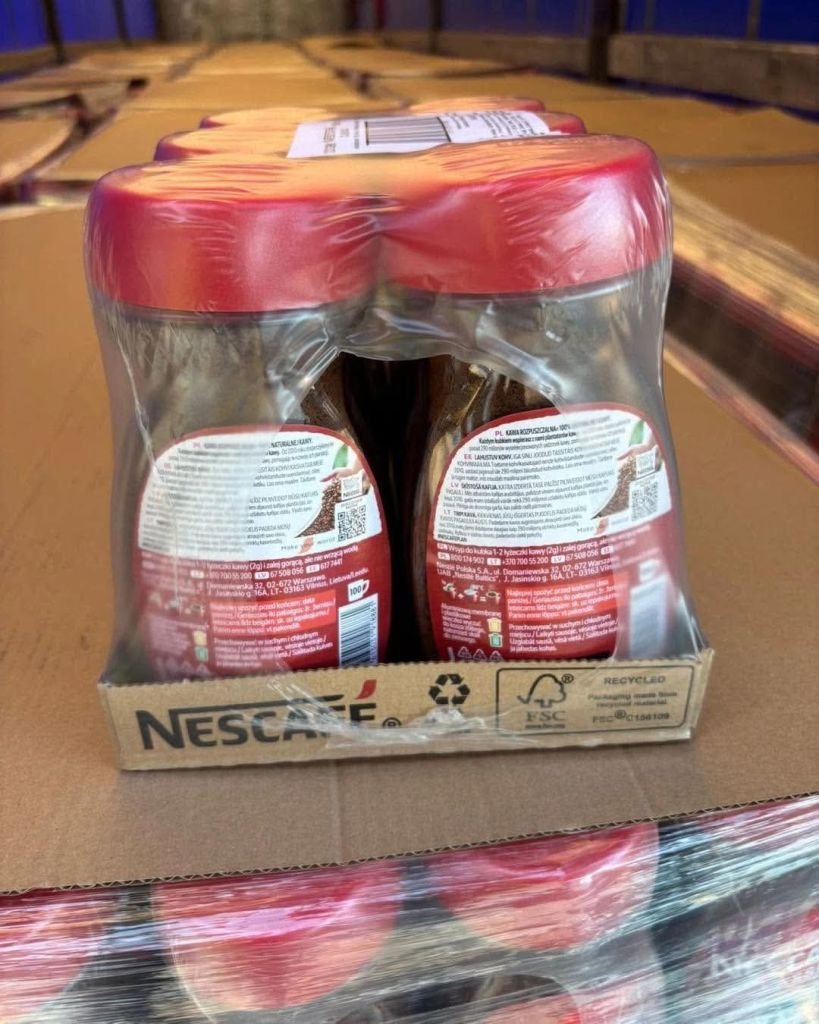
Classic jars displayed in shelf-ready retail formats.
When purchasing wholesale coffee lines, buyers must distinguish between individual sellable jars, shelf-ready display trays, and complete shipping cases. Documented packaging records in the NESCAFÉ German product identifier list detail 100 g, 200 g, and 220 g Classic glass options. In contrast, the Nestlé Hungary product list identifies flexible pouch refills such as 50 g and 150 g sizes.
Flexible refill bags reduce gross container weight and maximize shipping density compared to heavy glass containers. However, buyers should never assume a refill pouch SKU shares the outer case dimensions, pallet layer counts, or protective secondary packaging of glass jars. Specifying the exact closure type, container material, and net content helps suppliers prepare matching price schedules.
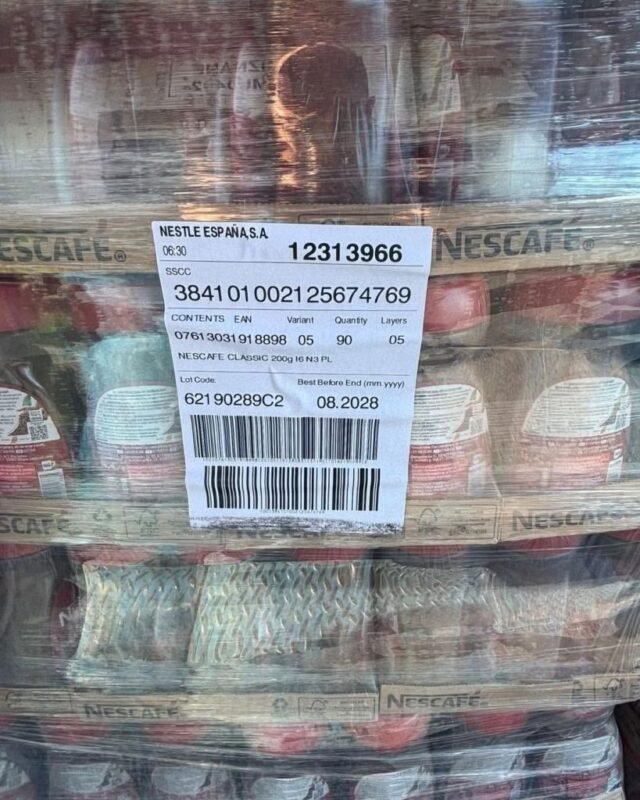
What your case label tells you
A verified case label for European NESCAFÉ Classic identifies item code 12313966, packed as 6 × 200 g jars equaling 1.2 kg net coffee, with outer case GTIN 07613031918898. According to the PBS Connect packaging record, this shipping case corresponds to consumer retail GTIN 7613031918881. The printed company addresses and multilingual text indicate regional distribution contacts rather than confirming the exact factory origin of a particular manufacturing lot.
Manufacturer process video documenting the industrial production of soluble instant coffee granules.
NESCAFÉ GOLD: Name, Weight, and Label Versions
Purchasing teams specify NESCAFÉ Gold wholesale inventory for premium retail shelves, executive office services, and upscale hotel catering. The product line is produced primarily in clear glass jars designed to showcase golden freeze-dried granules. Wholesale buyers must name the exact sub-brand, weight, and regional artwork variation because blending formulas and barcoding differ across territories.
NESCAFÉ GOLD glass jar presenting premium freeze-dried granules.
Official catalog listings such as the NESCAFÉ Gold 190 g page confirm specific regional glass formats featuring distinct Cyrillic front labeling. Sourcing departments must not rename this SKU as GOLD Blend or assume its country of production based solely on the script. Pallet loading figures and master carton counts should only be assigned when verified by an authorized technical specification sheet.
Wholesale specifications must clarify whether an inquiry demands GOLD Original, Mild, Crema, or Decaffeinated variants. The manufacturer’s German product identifier list records separate entries for GOLD Original in 100 g, 200 g, and 220 g jars. Each version features a unique retail GTIN, and blend compositions vary significantly to meet specific market taste profiles.
GOLD Original Specifications
- Available in documented 100 g, 200 g, and 220 g clear glass jars
- Standard roast profile catering to general export and supermarket retail
- Distinct retail and master carton GTIN numbers per container size
GOLD Specialty Formulations
- Separate sub-lines including Crema, Mild, and Decaffeinated editions
- Unique recipes requiring explicit confirmation of roasting depth and caffeine status
- Independent case layouts that must not be interchanged with standard GOLD stock
In wholesale logistics records, specialty lines like GOLD Dessert 200 g represent distinct commercial products. Logistics metrics for Dessert variants must remain strictly separate from standard GOLD or regional 190 g jars.
NESCAFÉ 3-in-1: Classic, Creamy Variants, and Strong
Wholesale buyers source NESCAFÉ 3-in-1 bulk sachets for high-volume grocery distribution, convenience chain merchandising, and workplace cafeterias. The format features single-serve sticks containing coffee powder, dairy or non-dairy creamer, and sweeteners grouped into flexible multi-serving consumer bags. Sourcing documentation must detail the stick grammage, sachet count per consumer bag, and outer master carton dimensions.
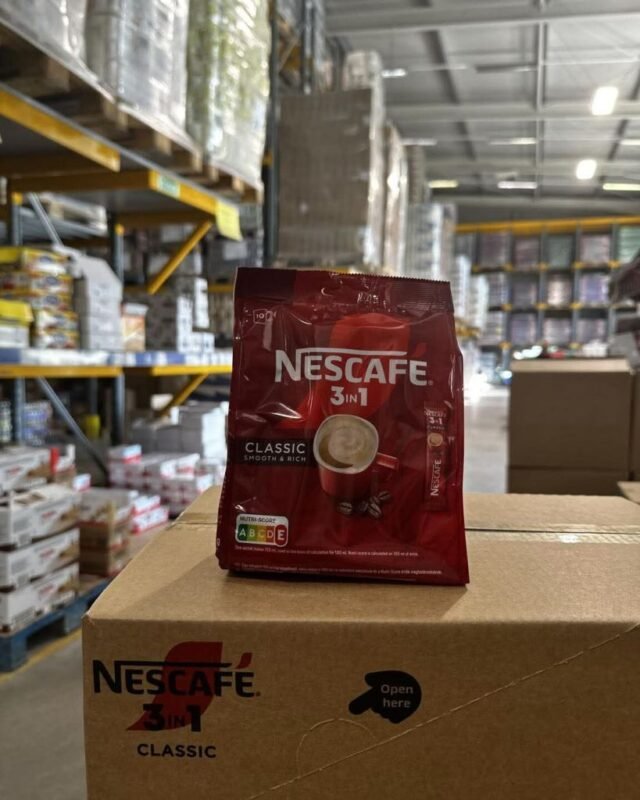
Multi-serve retail packaging for soluble 3-in-1 coffee sachets.
A procurement request stating only “10-stick bags” is insufficient to complete a commercial purchase order. For example, the Nestlé Hungary published list documents Classic 3-in-1 bags packed with 10, 24, or 30 sticks weighing 16.5 g each. Concurrently, a Dutch trade listing documents a 10 × 15.5 g retail format packed eight bags per outer grouping, proving that sachet net weight fluctuates across regional production batches.
Classic & Original
Standard balanced blend packed across varying formats from 10 to 30 sticks per bag with regional grammage differences.
Creamy & Milky
Formulations with higher creamer ratios such as Hungary’s Creamy Latte, Philippine Creamy White, and Malaysian White Coffee.
Strong & Rich
Robusta-forward profiles like Hungary’s 10 × 16 g and 24 × 16 g packs identified strictly by manufacturer codes.
Descriptive terms like “creamy” or “milky” correspond to strictly defined regional brand lines rather than a single global product code. European listings document Hungary Creamy Latte in 10 × 15 g sachets, whereas Southeast Asian markets market Philippine Creamy White and Malaysian White Coffee as independent formulas. Each variation carries its own ingredient listing, milk allergen declaration, and nutritional profile.
The Strong variant provides a more intense coffee flavor, verified on the NESCAFÉ Hungary Strong page. Sourcing teams identify Strong inventory by its explicit label title and barcode rather than relying solely on green packaging colors.
Purchasing orders must track the complete packaging chain: individual stick → consumer retail bag → intermediate outer carton → master shipping pallet. In a documented UK Original 96 g format, 6 sticks of 16 g form one retail pack, 11 retail packs pack into an outer carton (66 sticks total), and multiple cartons load onto a shipping pallet. Ordering “100 units” without specifying sticks, retail bags, or master cases leads to supply chain errors.
Commercial brand campaign showcasing the Creamy White format developed specifically for the Philippine retail market.
NESCAFÉ Spécial Filtre L’Original: Soluble Jars and Foodservice Packs
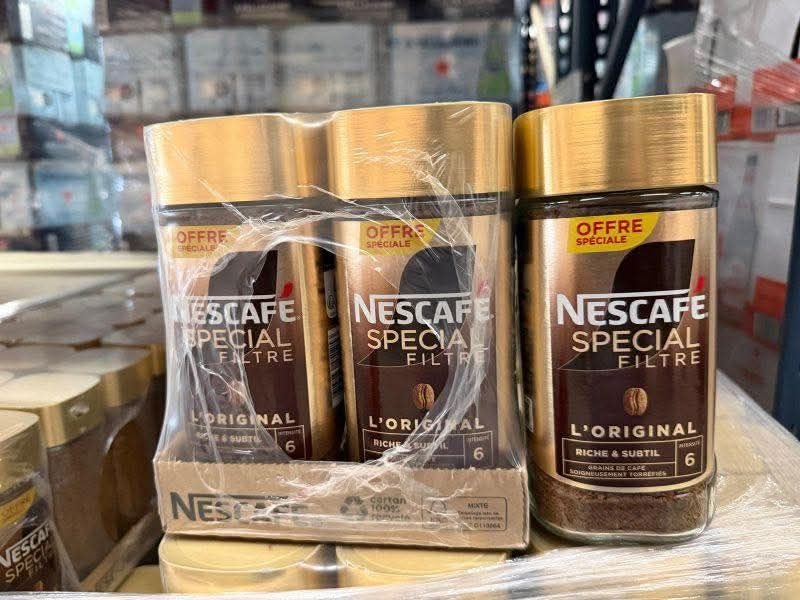
European grocers, premium hotels, and contract caterers specify NESCAFÉ Spécial Filtre L’Original for elevated soluble coffee service. Despite featuring the French word “Filtre” prominently on the container, the official NESCAFÉ L’Original page confirms this line is pure soluble coffee made from a blend of selected Arabica and Robusta beans. It dissolves instantly in hot water without requiring filter paper or brewing machines.
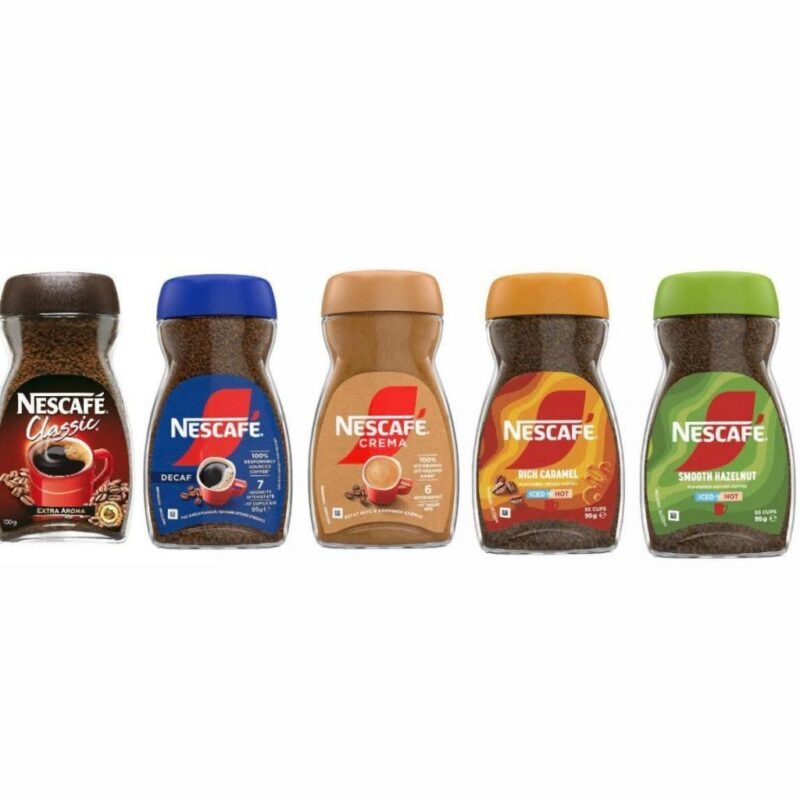
Soluble coffee stations prepared for professional foodservice presentation.
Retail distribution requires clear glass packaging with tamper-evident foil seals. Importers source documented 100 g glass jars for compact consumer displays or 200 g glass jars for standard retail shelves. Both retail sizes protect volatile coffee aromatics while providing clear product visibility to consumers.
Commercial caterers, conference venues, and automated vending operators select distinct industrial presentations. Nestlé Professional manufactures Spécial Filtre in single-dose 2 g sticks for hotel room amenity trays and large 500 g flexible pouches for high-volume automated dispensing machines. Vending operators require bulk foil pouches to refill hoppers efficiently, whereas hospitality operations demand individually sealed sticks to maintain portion hygiene.
Retail Glass Jars (100 g / 200 g)
- Rigid barrier protection preserving aroma on grocery shelves
- Recognized consumer branding suitable for supermarket merchandising
- Airtight twist caps maintaining quality after initial opening
Professional Foodservice Packs
- 2 g single-dose sticks eliminate measured scooping in guest rooms
- 500 g vending bags lack consumer resale barcoding and retail closures
- Higher freight weight efficiency for bulk catering operations
Case and Pallet Comparison Across Product Formats
Logistics planners and freight forwarders evaluate master carton dimensions and pallet stacking patterns before booking container capacity. Instant coffee by the pallet varies considerably in case count and layer structure depending on whether the product ships in heavy glass jars, lightweight tins, or flexible stick pouches. Sourcing managers must obtain verified packing sheets from the source loading facility prior to dispatch.
| Product and Evidence | Outer Case | Published Pallet Configuration |
| Classic 200 g (Item 12313966), case label & Makro record | 6 × 200 g jars | 108 jars per layer = 18 cases; 5 layers = 90 cases / 540 jars |
| GOLD Dessert 200 g, Solucious trade sheet (Item 41186) | 6 jars | 95 cases / 570 jars total pallet loading |
| 3-in-1 Original 96 g, Nestlé UK & HooGe list | 11 packs × 6 × 16 g | 27 cases × 7 layers = 189 cases / 2,079 retail packs / 12,474 sticks |
| Spécial Filtre 200 g, GTIN 3033710074525, Miamland listing | 6 jars | 95 cases / 570 jars total pallet loading |
| Spécial Filtre 2 g sticks, Nestlé Professional France | 12 boxes × 25 sticks | 16 cases × 8 layers = 128 cases / 1,536 boxes / 38,400 sticks |
| Spécial Filtre 500 g, Nestlé Professional Netherlands | 12 × 500 g bags | 24 cases / 288 bags / 144 kg net coffee |
| Original plain 1.8 g sticks, Nestlé Professional UK | 200 sticks | 28 cases × 8 layers = 224 cases / 44,800 sticks |
| Original 750 g tin, Nestlé Professional UK | 6 tins | 8 cases × 6 layers = 48 cases / 288 tins |
Published configurations by product. Confirm the offered case and pallet before ordering.
Standard European Stacking Ratio
6 jars × 18 cases × 5 layers = 540 jars
While the verified European case label confirms 540 jars across five tiers, alternative trade listings such as the Exportaste Classic record document 198 cases and 1,188 jars on a pallet under the identical retail consumer barcode. Pallet capacity varies based on whether logistics operators use 1200 × 800 mm Euro-pallets or standard 1200 × 1000 mm industrial bases.
Never calculate gross transport weights by simply multiplying the net weight of the coffee powder. Glass containers, corrugated dividers, shrink wrap, and wooden pallet skids contribute substantial tare weight. Sourcing teams must request formal packing lists from the loading dock to verify gross weights, tier counts, and container stowage limits.
European Production Facilities and Traceability Realities
Nestlé operates multiple specialized coffee processing facilities across Europe that supply regional and export distribution networks. Sourcing managers track manufacturing footprints to understand supply lead times and regulatory compliance. Commercial documentation must verify factory origin using official lot codes rather than distributor marketing addresses.
Girona, Spain
A flagship soluble coffee and beverage capsule complex documented by Nestlé Spain.
Dieppe, France
Historical freeze-dried and spray-dried coffee facility recognized by Nestlé France.
Szerencs, Hungary
Specialized processing center manufacturing 3-in-1 coffee mixes recorded by Nestlé Hungary.
Additionally, UK facilities like Tutbury process soluble lines documented by Nestlé UK & Ireland. These sites highlight the geographical breadth of European production. However, an importer should only tie a specific lot or quoted SKU to a manufacturing origin if the formal product certificate or container label explicitly declares it.
Distributor addresses, language panels, and barcode country prefixes do not establish manufacturing origin. In international supply chains, products manufactured in one country often feature retail contact addresses from another marketing territory. Customs clearance authorities require formal Certificates of Origin and matching manufacturer invoices to establish legal origin.
Footage documenting roasting and extraction processes inside the Girona manufacturing facility.
Southeast Asian Sourcing Considerations: Philippines, Malaysia, Indonesia
Importers across Southeast Asia balance domestic consumer preferences with international import logistics when sourcing wholesale coffee. Brand names, sweetness expectations, and creamer proportions vary sharply between neighboring regional markets. Purchasing teams must verify local consumer acceptance and statutory labeling requirements prior to booking cross-border cargo.
Philippines Sourcing
Examine distinctions between domestic NESCAFÉ Original and Creamy White before proposing an imported replacement label.
Malaysia Range
Differentiate between Original, Rich, Mild, and White Coffee formulas identified in the Malaysian brand range.
Indonesia Compliance
Confirm import registrations, language over-stickering requirements, and acceptable master carton hierarchies with customs brokers.
The scale of regional coffee procurement reflects significant consumer demand. According to the World Bank WITS database, the Philippines recorded US$562.7 million in imports of coffee extracts and preparations in 2025. This trade figure illustrates overall category import volume across the country rather than company-specific revenue.
Buyers expanding FMCG inventories across Southeast Asia often combine dry beverage orders with complementary packaged food lines. Review our Southeast Asia grocery buying guide to study distribution requirements, container consolidation options, and temperature-controlled freight considerations across regional transit corridors.
Specifications Required for an Accurate Wholesale Quotation
Wholesale pricing for branded coffee depends on real-time market availability, currency valuations, order volume, and destination logistics. As an independent sourcing company, Zeki Frucht reviews availability and prepares formal quotations against specific buyer requests. We do not maintain static price lists because raw product costs and shipping rates fluctuate continuously.
To receive an accurate commercial quotation, purchasing teams should provide clear procurement parameters:
- Exact product name and sub-brand (e.g., Classic, GOLD Original, Spécial Filtre)
- Container format (glass jar, flexible refill pouch, single-serve stick, or bulk bag)
- Net weight per retail unit in grams
- Known retail barcode (EAN/GTIN) and outer master carton identifier
- Order volume expressed as total cartons or complete pallet counts per SKU
- Destination seaport or delivery terms (FOB, CIF, or CFR)
- Permitted label language versions and mandatory over-stickering requirements
- Minimum acceptable remaining shelf life upon arrival at destination
Explore our general NESCAFÉ product listing and our dedicated wholesale coffee range to review parallel commercial offerings. Mixed product orders, consolidation feasibility, freight schedules, and lead times remain subject to final confirmation upon order review.
Submit Your Commercial Sourcing Request
Provide your target SKU identifiers, required pallet quantities, and destination port details to receive a formal quotation from our sourcing team.
Frequently Asked Questions About NESCAFÉ Wholesale
How many Classic 200 g jars fit on a pallet?
A standard European pallet configuration for Classic 200 g jars (item 12313966) holds 540 jars arranged as 18 cases per layer across 5 tiers. Alternative trade configurations record up to 1,188 jars depending on pallet base dimensions and ceiling clearance limits. Buyers must confirm the specific pallet specification sheet offered for their lot before booking transportation.
Is GOLD 190 g the same as GOLD Original 200 g?
No, GOLD 190 g and GOLD Original 200 g are distinct commercial products with different net contents, retail barcodes, and target market labeling. The 190 g jar format features regional artwork and Cyrillic text, whereas GOLD Original 200 g serves broader European export markets. Sourcing managers must not treat their logistics data or blend profiles as interchangeable.
What is the difference between plain sticks and 3-in-1 sachets?
Plain sticks contain pure soluble instant coffee powder without additives, designed for measured black coffee service in hotels and offices. In contrast, 3-in-1 sachets contain a composite coffee mix blending soluble granules with non-dairy creamer and sugar. These formats represent different product categories, tariff classifications, and master carton configurations.
How do I confirm where the coffee was made?
Manufacturing origin must be verified using the official production batch lot code and manufacturer shipping documentation. Front packaging language, barcode country prefixes, and distributor headquarters addresses do not confirm the processing factory. Customs compliance requires an authentic Certificate of Origin issued by the exporter.
What do you need for a quote?
To prepare an accurate quotation, we require the exact product sub-brand, net weight, packaging format, order quantity in full cases or pallets, destination port, acceptable label languages, and minimum shelf life requirements. Providing specific retail GTINs or manufacturer article numbers accelerates verification.
Reliable Procurement for Global Coffee Brands
Successful international coffee procurement depends on verifying exact case codes, net weights, and pallet layer configurations before committing cargo space. Commercial buyers who establish clear specifications for container packaging, label languages, and delivery terms secure predictable supply chains across global trade lanes.