

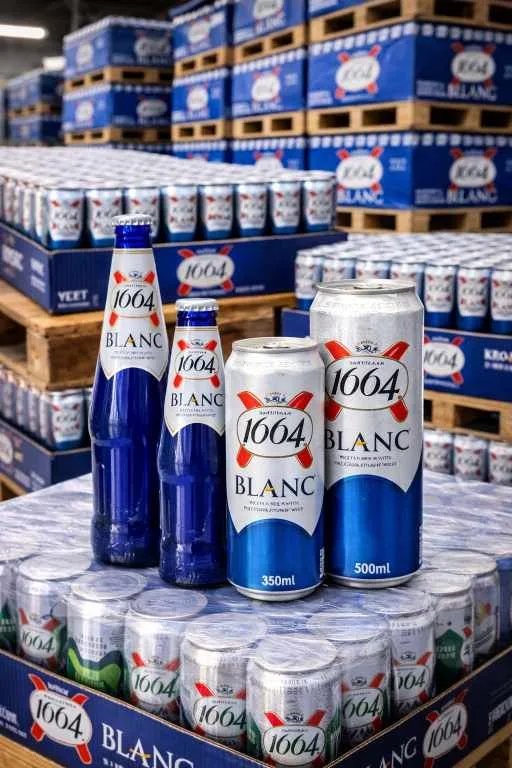
1664 Blanc wholesale buyers in the Philippines need to compare more than the price of an imported beer case. The choice between 330ml glass bottles and 500ml aluminium cans affects case specifications, handling, labelling and total landed cost.
Both formats are documented in international manufacturer and trade references, but the exact export carton, production origin and remaining shelf life must be confirmed for the goods being offered. Zeki Frucht GmbH evaluates qualified commercial sourcing requests for importers and distributors requiring genuine 1664 Blanc products, clearly identified packaging and an accurate wholesale quotation.
Format Comparison: 330ml Bottles and 500ml Cans
Selecting the appropriate container format directly determines transport density, breakage allowances, and retail channel placement across Philippine commercial networks. Importers evaluate glass bottles primarily for upscale dining, hotel bars, and premium hospitality venues, whereas aluminium cans deliver distinct advantages for supermarket distribution and nationwide inter-island shipping.
Product specifications published by the Carlsberg Group 1664 Blanc overview establish that both packaging variants share the core wheat beer recipe, containing citrus notes, sweet orange peel, and coriander spice at 5% alcohol by volume. Regional documentation from Carlsberg Malaysia product documentation confirms the ongoing market availability of both the 330ml bottle and the 500ml can within Southeast Asian distribution channels.
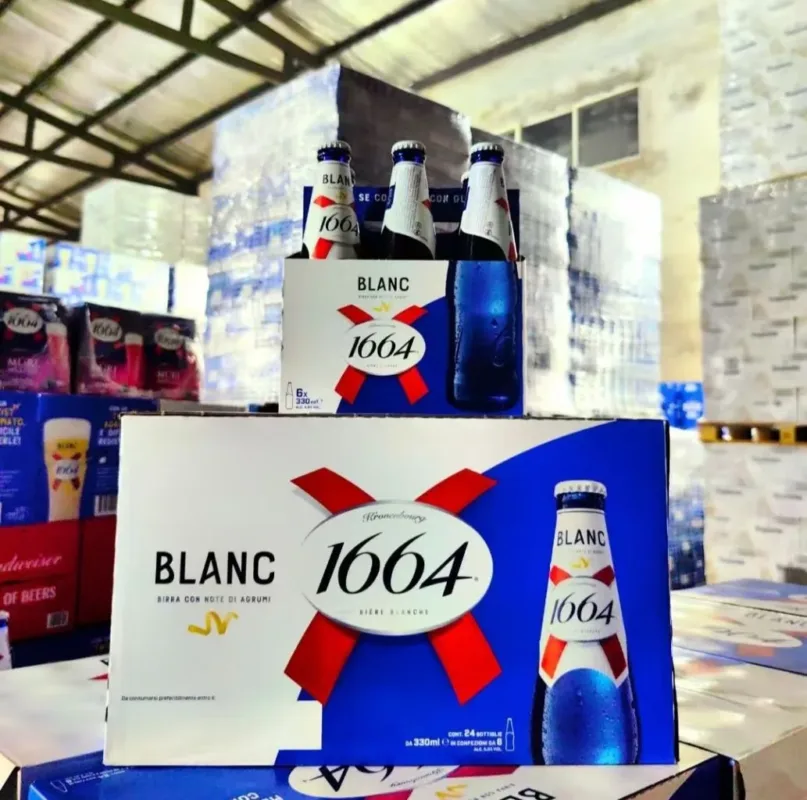
Wholesale packaging formats demand rigorous verification of secondary packaging and outer carton construction prior to dispatch.
For procurement teams assessing a 1664 Blanc 330ml bottle wholesale arrangement, standard European trade documentation lists export master cartons packed with 24 bottles of 330ml, yielding a total liquid volume of 7.92 liters per case. Buyers evaluating 1664 Blanc 500ml cans wholesale must examine the exact secondary packaging; while regional distributor listings often cite 24 cans containing 12 liters of liquid volume, this configuration is not universal across all international brewery origins.
- Container material: Tinted cobalt blue glass providing UV filtration.
- Unit capacity: 330ml net liquid volume per single bottle.
- Published case configuration: Documented trade case contains 24 units.
- Total liquid volume: 7.92 liters per master carton.
- Gross shipping weight: Higher tare weight due to glass mass.
- Carton protection: Requires internal corrugated dividers to prevent contact.
- Labelling requirements: Front, back, and neck labels with adhesive backing.
- Product origin: European or licensed regional production facilities.
- Handling differences: Vulnerable to impact breakage and transit vibration.
- Pallet verification: Lower carton counts per pallet due to weight limits.
- Commercial distribution: Ideal for on-premise dining, clubs, and hotel minibars.
330ml Blue Glass Bottle
- Container material: Lined food-grade aluminium offering total light barrier.
- Unit capacity: 500ml net liquid volume per single can.
- Published case configuration: Documented regional case example contains 24 units.
- Total liquid volume: 12.00 liters per documented 24-unit arrangement.
- Gross shipping weight: Lower packaging tare weight relative to volume.
- Carton protection: Shrink-wrapped trays or outer fiberboard master boxes.
- Labelling requirements: Directly printed can body or applied market stickers.
- Product origin: Regional Southeast Asian or European brewing centers.
- Handling differences: Susceptible to rim denting and external carton compression.
- Pallet verification: Higher liquid density per cubic meter of cargo space.
- Commercial distribution: Well suited for convenience retail and off-premise sales.
500ml Aluminium Can
Importers who also supply wider regional accounts can review our earlier guide on 1664 Blanc wholesale for Asian importers to examine cross-border packaging trends. Comparing these two container types allows purchasing teams to calculate accurate ocean container weight allowances and avoid demurrage from unexpected packing configurations.
Commercial Presentation and Brand Positioning
Kronenbourg 1664 Blanc occupies a distinct super-premium wheat beer segment across Asian retail and entertainment hubs. Marketing initiatives highlight modern French elegance, refreshing citrus aromas, and visual prestige driven by the signature blue container.
Promotional campaigns produced for specific Asian territories illustrate how brand assets drive consumer recognition. The commercial presentation below features actor Robert Pattinson in an official campaign produced specifically for South Korea, highlighting the premium lifestyle imagery associated with the brand.
This promotional material reflects South Korean domestic market positioning rather than localized Philippine advertising. Importers utilize these international brand assets to assess consumer demand, recognizing that local marketing execution in the Philippines must comply with domestic alcohol advertising guidelines and retail shelf requirements.
Philippine Beer Import Market and Regional Dynamics
Commercial beverage trade into the Philippines demonstrates ongoing expansion within the premium and imported beer categories. Independent data published by the World Bank World Integrated Trade Solution platform documents sustained growth in foreign beer procurement.
According to reported trade statistics, 2024 Philippine malt-beer imports totaled approximately US$8.68 million as recorded in the WITS 2024 Philippine malt beer import records. For the following trade period, recorded imports reached approximately US$9.71 million, representing approximately 11.8% growth in import value, with import volume reaching approximately 7.49 million liters as documented in the WITS 2025 Philippine malt beer import records.
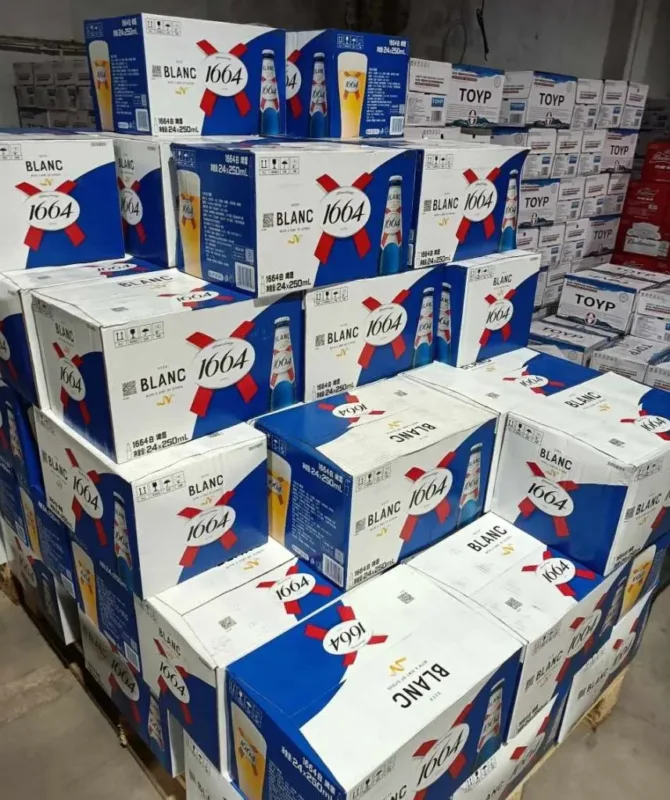
Import declarations for malt beer under HS Code 220300 reflect nationwide trade flows across all foreign commercial brewing partners.
These macroeconomic trade figures encompass all imported malt beers categorized under international trade code HS 220300, rather than specific brand volumes for 1664 Blanc. Philippine commercial distributors must evaluate this import environment alongside established domestic brewing networks, including San Miguel Brewery and Asia Brewery, which dominate volume consumption across mass-market segments.
French brand heritage must be distinguished from actual manufacturing origin. While Kronenbourg originated in Strasbourg, France, Carlsberg operates regional brewing facilities across Southeast Asia that supply international distributors.
Commercial procurement teams must verify the specific brewing facility declared on shipping manifests. Carlsberg maintains established regional manufacturing hubs, including facilities detailed in the Carlsberg global presence in Vietnam overview, which serve specific geographic markets under strict licensed quality standards.
Technical Packaging and Pallet Specifications
International logistics calculations require verifiable packaging dimensions, case gross weights, and container utilization figures. Estimating freight allocations based on unconfirmed packaging configurations creates significant risk of axle weight violations or broken cargo during maritime transit.
The technical table below presents published manufacturer figures and verified commercial export configurations for both primary formats. Where specific parameters vary based on the supplying European or regional bottling plant, values are explicitly designated as requiring commercial supplier confirmation.
| Specification Metric | 330ml Glass Bottle | 500ml Aluminium Can | Commercial Verification Notes |
| Container Material | Tinted Glass | Aluminium | Glass requires heavier secondary packaging partitions. |
| Unit Net Capacity | 330ml | 500ml | Net liquid volume declared on primary container label. |
| Units per Case | 24 Units | 24 Units | Can configurations vary; supplier confirmation required for batch. |
| Total Net Volume | 7.92 Liters | 12.00 Liters | Calculated for a standard 24-unit outer master case. |
| Retail Barcode | Check Batch | Check Batch | GTIN varies by target regional consumption territory. |
| Case Gross Weight | Check Batch | Check Batch | Tare weight depends on outer carton fiberboard grade. |
| Pallet Stacking Count | Check Batch | Check Batch | Loading tier patterns depend on maritime pallet standards. |
| Manufacturing Plant | Check Batch | Check Batch | Factory origin certified via commercial certificate of origin. |
Wholesale purchasers must avoid assuming identical pallet counts across different bottling runs. A Kronenbourg 1664 Blanc bulk supplier will establish the exact carton footprint, tier interlocking pattern, and maximum pallet height when issuing a formal proforma invoice.
Philippine Import Regulations and Compliance Steps
Importing commercial alcohol into the Philippines requires strict adherence to multi-agency regulatory frameworks. Sourcing partners and importers must coordinate administrative filings before cargo departs the origin brewery to avoid border holds.
Clearance protocols involve four primary statutory bodies: food safety registration with the Philippine Food and Drug Administration, customs accreditation through the Bureau of Customs, internal revenue excise compliance via the Bureau of Internal Revenue, and tariff classification monitoring on the Philippine National Trade Repository.
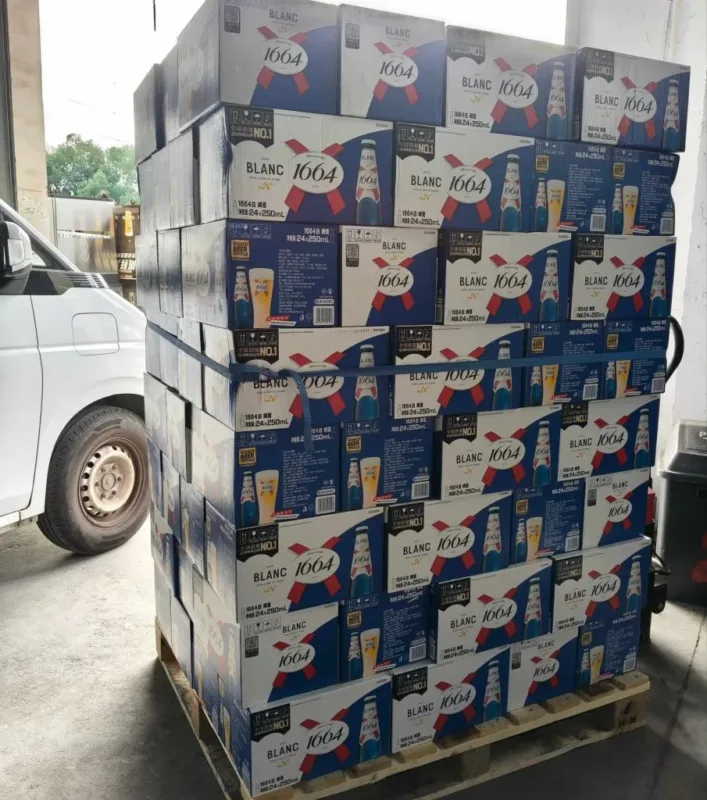
Customs clearance requires synchronized documentation between origin export certificates and Philippine import declarations.
Prospective importers must follow an established sequence of regulatory milestones to maintain compliance throughout commercial operations:
- Corporate Licensing: Secure a valid License to Operate as an alcohol importer and distributor from the Philippine Food and Drug Administration.
- Product Registration: Obtain a verified Certificate of Product Registration for each specific SKU and container volume prior to commercial dispatch.
- Customs Accreditation: Complete formal importer registration with the Bureau of Customs Accounts Management Office to enable electronic entry lodgement.
- Tax Assessment: File appropriate Authority to Release Imported Goods documentation with the Bureau of Internal Revenue and settle applicable specific excise taxes.
- Cargo Clearance: Submit verified commercial invoices, packing lists, ocean bills of lading, and certificates of origin for port inspection and duty assessment.
Packaging labels must also satisfy domestic retail standards, displaying mandatory health warnings, allergen declarations, importer contact details, and registered batch identification. Zeki Frucht GmbH operates as an independent sourcing specialist and does not replace the importer of record; consignees remain responsible for their local regulatory permits and customs declarations.
Verification, Packaging Protection, and Landed-Cost Structure
Maintaining product stability during maritime transport across tropical routes requires careful cargo management. Wheat beers contain active aroma compounds and natural haze proteins that degrade if subjected to severe temperature abuse or rough physical transit.
Buyers working with a 1664 Blanc beer supplier Philippines must implement a rigorous ten-point physical verification protocol upon cargo arrival:
- Authentic brand markings, typography, and official crown or lid seals.
- Accurate container format matching approved purchase orders.
- Declared alcohol content of 5% ABV and verified ingredient listings.
- Factory batch code matching the commercial certificate of analysis.
- Documented production date and clear best-before stamping.
- Sufficient remaining shelf life to accommodate regional storage and retail distribution.
- Mandatory Philippine market back-labelling or approved over-stickers.
- Structural integrity of secondary corrugated cases or shrink trays.
- Verified case counts per pallet load against dispatch manifests.
- Adequate thermal liners, desiccant bags, and pallet strapping.
Risk profiles differ substantially between glass bottles and aluminium cans. Glass bottles risk hairline stress fractures and total package shattering under improper pallet stacking, whereas cans present risk of corner creasing, pinhole leaks, and side-wall denting when subjected to lateral container shifting.
| Cost Component | Expense Category | Calculation Basis | Operational Responsibility |
| Merchandise | Base Product | Ex-Works or FCA | Agreed supplier invoice price per master carton. |
| Freight | Ocean Transit | Container Rate | Shipping line booking to Manila, Cebu, or Subic Bay. |
| Insurance | Cargo Risk | Declared Value | Marine cargo policy covering breakage and loss. |
| Duties & Taxes | Fiscal Revenue | Customs Value | Philippine customs duties, specific excise, and VAT. |
| Port Handling | Terminal Fees | Per Container | Wharfage, arrastre, and customs brokerage processing. |
| Inland Delivery | Final Haulage | Trucking Rate | Transfer from discharge terminal to regional warehouse. |
Commercial transactions must define operational liability by applying recognized trade definitions outlined in the ICC Incoterms rules reference. Sourcing quotations clearly separate ex-works merchandise values from ocean freight and cargo insurance allowances.
Authentic Brewing Heritage and Manufacturing Insight
Understanding the brewing methodology of Kronenbourg 1664 Blanc assists commercial buyers in communicating product quality to retail accounts. The brew is distinguished by its blend of pale malt, wheat, and delicate spicing that creates its characteristic pale golden haze.
The manufacturing process film below presents the industrial brewing environment of Brasseries Kronenbourg, demonstrating the automated production cycles, brewhouse management, and packaging logistics established at their European facilities.
This technical presentation illustrates general European brewing operations and packaging standards. Visual documentation of brewery infrastructure does not establish the specific manufacturing site of a proposed commercial export lot, which is certified exclusively through verified origin documentation for each order.
Sourcing Verification and Commercial Quotations
Zeki Frucht GmbH functions as an independent wholesale sourcing business operating from Vienna, Austria. We do not maintain unallocated static inventory or hold exclusive brand distribution rights; instead, our trading desk evaluates availability and pricing against confirmed commercial purchase orders.
Importers seeking to expand their premium beverage catalog can review our wider alcoholic drinks sourcing options for complementary European beer, cider, and spirit allocations. Sourcing requests can combine 330ml bottles and 500ml cans into a single consolidated enquiry where warehouse staging and weight allowances permit.
To obtain an accurate export quotation, buyers must submit detailed operational parameters including company registration, packaging format, requested volume, target discharge port, and acceptable shelf life.
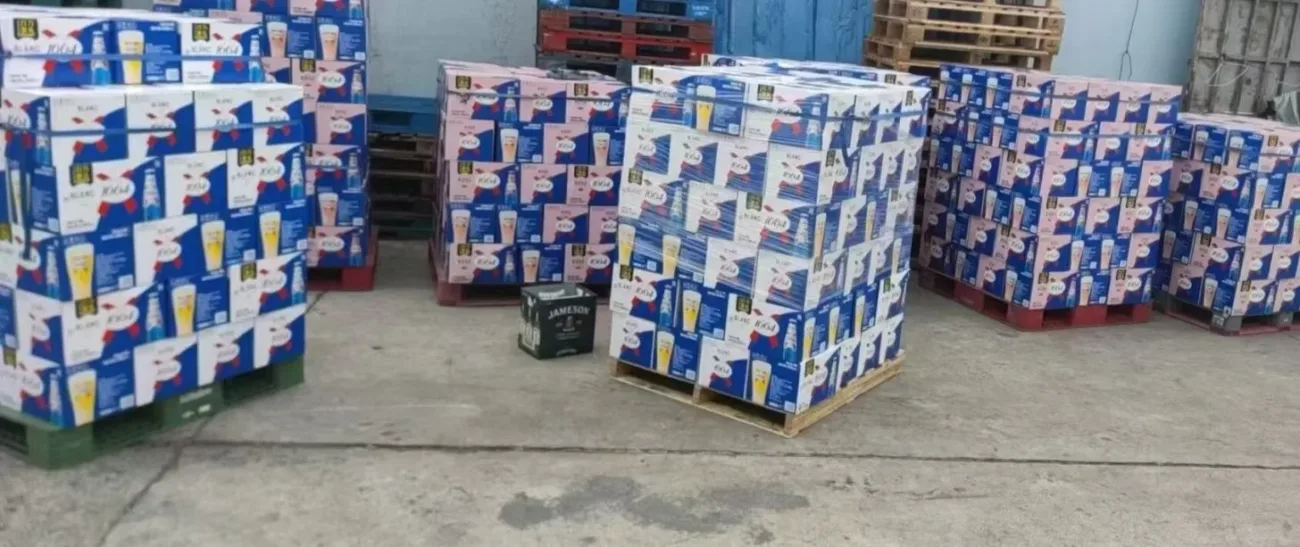
Every wholesale quotation includes verified batch inspection parameters and documented transport terms.
Commercial enquiries are reviewed for established corporate buyers who provide complete business credentials. Supplying exact destination requirements enables our desk to check real-time factory availability and calculate competitive ocean freight schedules.
Frequently Asked Questions
What is the difference between 1664 Blanc 330ml bottles and 500ml cans for Philippine wholesale?
The 330ml blue glass bottle provides a traditional visual presentation suited for on-premise hospitality, while the 500ml aluminium can provides higher liquid volume with lower shipping tare weight for retail shelves. Each packaging type requires different outer carton handling and customs entry documentation.
How does an importer confirm the manufacturing origin of a 1664 Blanc shipment?
Manufacturing origin is verified through the official Certificate of Origin, the declared bottling facility on the manufacturer commercial invoice, and physical lot codes stamped on containers. Brand headquarters or barcode country prefixes alone do not identify the bottling facility.
Can Philippine buyers request 330ml bottles and 500ml cans in a single sourcing quotation?
Yes, buyers can combine both packaging formats into a single commercial enquiry. Consolidation feasibility depends on export warehouse staging locations, minimum order quantities per format, and container weight limits.
What minimum remaining shelf life is standard for wholesale ocean shipments?
Acceptable shelf life parameters must be specified by the buyer during initial commercial intake. Commercial export shipments generally require several months of verified remaining shelf life to accommodate maritime transit, customs clearance, and regional distribution.
What regulatory registrations are required before importing 1664 Blanc into the Philippines?
Importers must maintain a valid Food and Drug Administration License to Operate, an active Certificate of Product Registration for the specific SKU, Bureau of Customs importer accreditation, and Bureau of Internal Revenue excise registration. Sourcing partners provide trade documentation to support local customs filing.
Next Steps for Commercial Sourcing in the Philippines
Establishing an efficient supply route for Kronenbourg 1664 Blanc requires careful balance between container formats, regulatory filings, and transport logistics. Evaluating outer carton specifications and shelf-life parameters before order confirmation helps buyers maintain supply chain stability across Philippine distribution channels.
Request a 1664 Blanc Wholesale Quote
Submit your company details, packaging requirements, target volume, and preferred Philippine discharge port to receive a formal commercial assessment.