
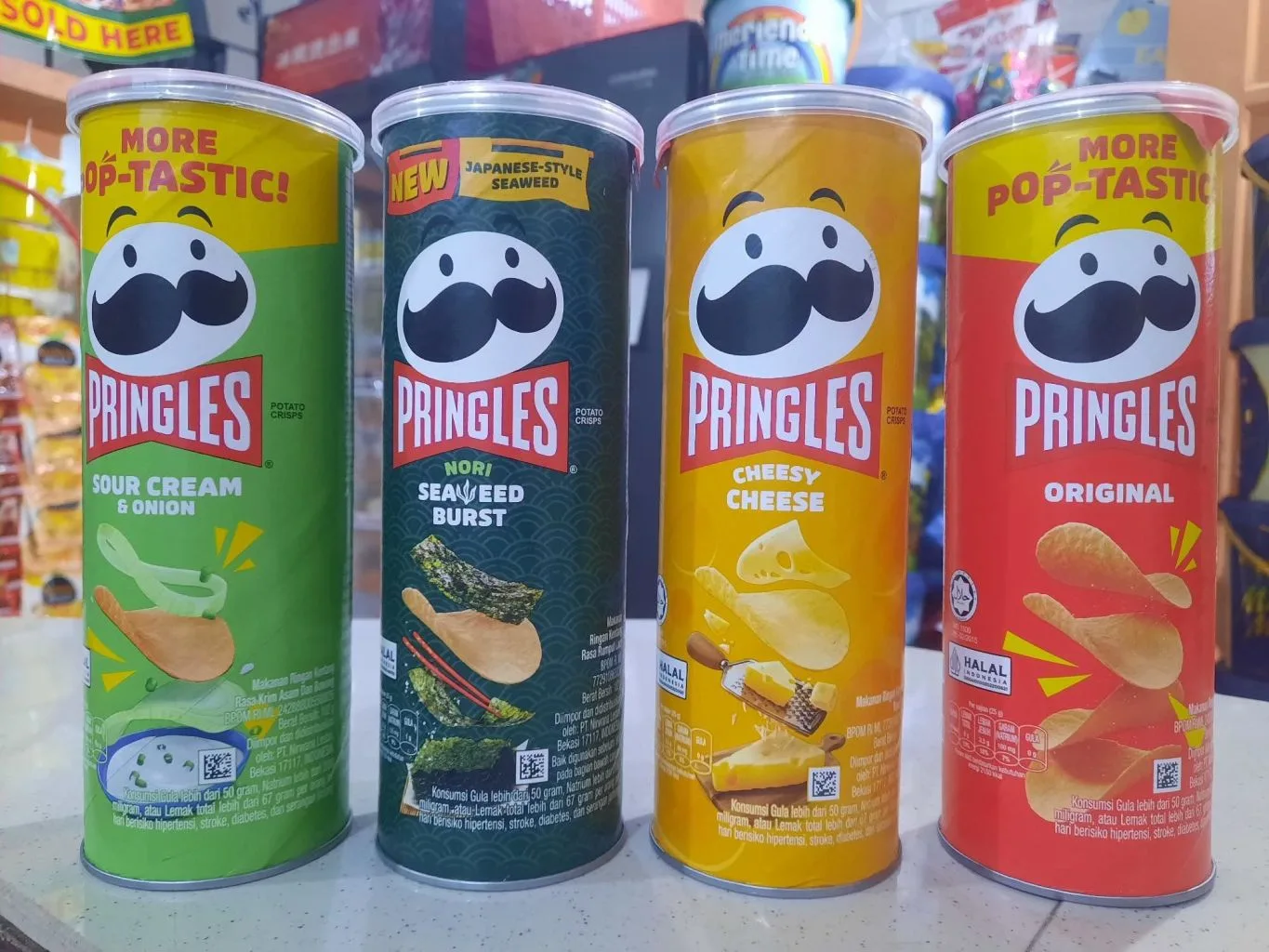
Commercial grocery distributors expanding their savory snack inventory can source Pringles wholesale Kazakhstan shipments through structured cross-border procurement channels. Sourcing these recognizable stacked potato crisps requires verifying specific retail canister sizes, packaging languages, master carton dimensions, and regional customs compliance before dispatch.
We evaluate wholesale supply requests against confirmed commercial orders, assessing availability across Zeki’s established commercial sourcing channels to prepare structured multi-pallet and truckload quotations. Your delivery schedule and final landed pricing depend on verified batch shelf life, required destination labeling, transport mode, and current supply conditions.
Selecting Pringles Formats for Central Asian Distribution
Selecting suitable canister formats determines your retail positioning and freight density across regional retail networks. The brand packages crisps into several distinct cylindrical canister weights designed for different consumption occasions and retail channels.
The compact 40g canister serves grab-and-go convenience outlets, transport hubs, vending networks, and impulse checkouts throughout urban centers like Almaty and Tashkent. The intermediate 70g tube offers a portable portion for forecourt convenience marts, while the 165g canister represents the dominant family-sharing volume for modern supermarket aisles and hypermarket endcaps.
Flavour selection must reflect regional consumer preferences while verifying current production availability. According to the official Pringles Central Europe product catalogue, core recipes include Original, Sour Cream & Onion, Classic Paprika, and Hot & Spicy, alongside specialty recipes like Cheesy Cheese and Texas BBQ. We confirm availability per recipe for each quotation because production runs vary across manufacturing schedules.
| Tube weight | Purchasing consideration | Packaging checks |
| 40g canister | Impulse retail | Check seal integrity, counter-top display outer carton style, and individual tube barcode compatibility. |
| 70g canister | Forecourt sales | Verify case packaging density, remaining shelf life, and retail shelf height compatibility. |
| 165g canister | Supermarket grocery | Confirm master case count, lid security, localized over-stickering space, and pallet tie-tier patterns. |
Pringles: An Established International Snack Brand
Pringles maintains global consumer recognition driven by high-profile international marketing and signature hyper-curved chip geometry. International advertising campaigns reinforce steady retail pull across emerging and developed grocery markets worldwide.
This brand commercial illustrates the universal appeal and fun consumer positioning that support retail shelf turnover. Broadcasting footage represents promotional brand marketing rather than direct factory distribution partnerships or guaranteed inventory allocation.
What Pringles Importers Should Evaluate in Kazakhstan and Uzbekistan
Commercial importers entering the snack sector in Kazakhstan and Uzbekistan operate within established markets featuring existing wholesale trade flows. Entering these markets successfully requires competing on landed unit costs, fresh production runs, and rigorous compliance rather than assuming inventory scarcity.
In both territories, major supermarket chains and traditional bazaar wholesalers demand minimum remaining shelf-life thresholds, typically requiring at least eight to ten months upon customs clearance. Sourcing batches with short remaining validity leads to steep retail discounting and inventory write-offs.
Commercial order sizes directly influence your transport efficiency and landed unit margin. Full truckload shipments or standardized container configurations spread fixed clearance and documentation costs over higher tube counts, helping you maintain competitive pricing against established market distributors.
Evaluate your target retail network’s acceptance of multilingual over-stickers versus direct-print packaging before confirming purchase orders to avoid customs delays at inland bonded terminals.
Pringles Shipping Cases: From Retail Tubes to Commercial Orders
Understanding master carton construction helps commercial buyers calculate accurate cubic capacity, payload weights, and landed unit economics. Sourcing branded snacks requires evaluating three distinct commercial levels: individual retail canisters, corrugated master shipping cases, and stacked pallet units.
Documented packaging configurations demonstrate how case builds vary across formats. For example, standard 165g retail canisters frequently ship in cases containing 19 tubes, yielding a net product content of 3.135kg (19 × 165g = 3.135kg). Conversely, convenience 40g canisters typically ship packed 12 tubes per carton, representing a net product content of 0.480kg (12 × 40g = 0.480kg).
These documented figures serve as reference packaging examples rather than universal specifications across every manufacturing run. Buyers must confirm whether master cases use retail display trays or closed transit cartons, as carton dimensions directly influence layer nesting and total pallet counts.
| Retail size | Units per documented case | Net product content | Details to verify |
| 40g tube | 12 tubes | 0.480kg net | Confirm inner carton display punch-outs, outer case barcode, and gross carton shipping weight. |
| 70g tube | 12 tubes | 0.840kg net | Check total carton height, stacking strength limits, and master pack gross kilogram weight. |
| 165g tube | 19 tubes | 3.135kg net | Verify exact layer tie patterns, master carton barcode format, and vertical crush-resistance rating. |
Warehouse management systems require differentiating between retail GTINs printed on individual canisters and ITF-14 case barcodes printed on shipping cartons. Commercial purchasers must verify both codes prior to dispatch to prevent intake discrepancies at regional distribution centers.
Kazakhstan vs Uzbekistan: Import Labeling Checklist
Import compliance represents a critical divide between Central Asian trade jurisdictions. While both nations share historical trading ties, their regulatory architectures operate under distinct statutory frameworks that dictate food labeling requirements.
Kazakhstan functions under the Eurasian Economic Union (EAEU) customs framework, enforcing Technical Regulation TR CU 022/2011 regarding food product labeling. Goods cleared for Kazakhstan must display product information in both Kazakh and Russian languages, including full ingredient lists, net weight, nutritional values, manufacturing dates, and local importer registration details.
Uzbekistan enforces independent national import regulations separate from the EAEU framework. Food imports cleared into Uzbekistan require compliant Uzbek-language product information, specific national conformity documentation, and authorized local entity details. Review official commercial guidance via the Kazakhstan labeling guide and the Uzbekistan labeling requirements before approving dispatch.
| Market | Label language | Ingredients/allergens | Net weight | Date marking | Importer information | Applicable conformity requirements and documentation |
| Kazakhstan | Kazakh & Russian | Mandatory bolding | Metric grams | Day/month/year | Local entity name | EAEU TR CU 022/2011 technical regulation declarations and veterinary/phytosanitary clearance where relevant. |
| Uzbekistan | Uzbek language | Full disclosure | Metric grams | Standard format | Registered entity | National certificates of conformity, state registration, and mandatory language verification on retail packaging. |
Planning Pringles Pallet Deliveries to Central Asia
Kazakhstan and Uzbekistan are landlocked countries requiring careful inland routing and multimodal coordination. Shipping fragile potato crisps across long overland transit corridors requires robust pallet stabilization, moisture barriers, and temperature management during seasonal extremes.
Buyers must define the complete operational scope when requesting freight estimates. You must identify the supplier’s verified dispatch terminal, your designated inland customs clearance terminal (such as Almaty, Astana, or Tashkent), required pallet stack heights, and gross consignment weight.
Commercial Incoterms dictate where risk and logistics costs transfer. According to official ICC Incoterms rules, terms such as CPT (Carriage Paid To) prove practical for inland road freight or intermodal rail container arrivals. Maritime terms like CIF apply only to sea or inland waterway transport and cannot cover delivery to landlocked inland dry ports.
Calculate total landed costs by incorporating ex-works cargo value, overland freight, cargo insurance, customs duties, value-added tax, terminal handling, and local trans
How Buyers Check a Pringles Supplier’s Offer
Rigorous pre-shipment checks protect your commercial investment against unauthorized stock diversions or incorrect packaging variants. Commercial snack quotations must clearly document critical batch parameters before purchase agreements are executed.
Review every quotation against a rigorous technical checklist:
- Specified flavour name and exact canister et weight (such as 40g, 70g, or 165g).
- Verified retail barcode (EAN/GTIN) and master shipping case code (ITF-14).
- Exact tube count per master shipping case and outer carton dimensions.
- Country of manufacture and the verified dispatch facility location.
- Specific production batch codes, packaging dates, and guaranteed best-before dates.
- Packaging print languages and compliance with target destination labeling laws.
Do not assume that GS1 barcode prefix numbers prove manufacturing origin. A country prefix merely identifies the national numbering organization where the brand owner registered the code, not the physical factory where the crisps were baked and packed.
Request high-resolution photographs of master carton label panels showing lot stamps and expiry dates before releasing final commercial payments.
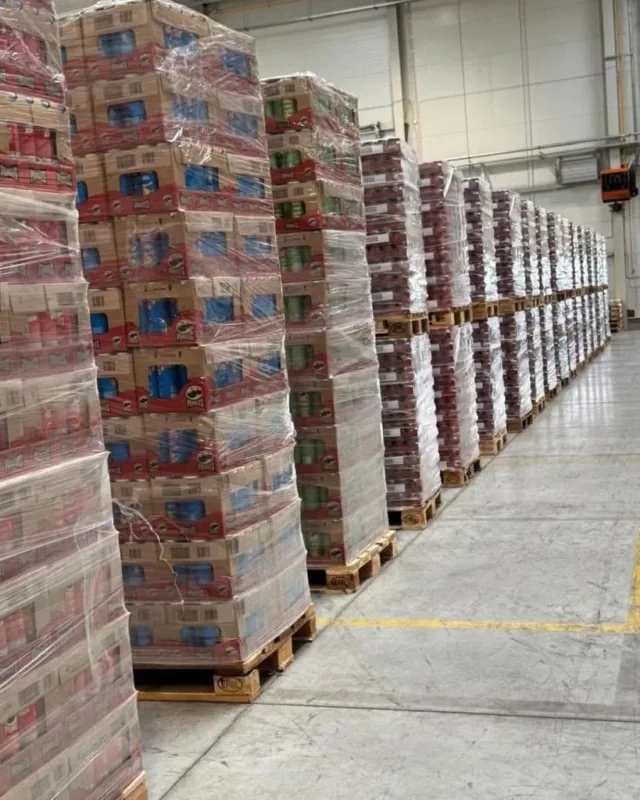
Inspecting master carton labeling verifies batch identification and barcode consistency before loading.
How Pringles Are Manufactured and Packed
Understanding the industrial production of Pringles clarifies why the brand maintains distinctive structural durability during international logistics. The manufacturing process transforms potato dough into standardized saddle-shaped hyperbolic paraboloid crisps designed to nest closely inside rigid foil-lined canisters.
This documentary footage illustrates how automated dough rolling, precision cutting, flash frying, seasoning dispersion, and high-speed rotary tube filling preserve product crispness. Historical manufacturing media demonstrates industrial packaging methods but does not represent current factory allocations or Zeki’s specific commercial batch origin.
Requesting a Commercial Pringles Sourcing Offer
Zeki Frucht GmbH functions as an independent Austrian B2B sourcing company operating from Vienna. We coordinate branded FMCG sourcing against confirmed buyer requirements, checking current availability across Zeki’s established commercial sourcing channels to assemble accurate, transparent commercial offers.
Our commercial sourcing workflow follows three sequential stages:
- The buyer submits complete corporate details, desired product SKUs, packaging sizes, and target delivery destinations.
- Our procurement desk reviews real-time batch availability, production dates, and transport logistics.
- We issue a structured commercial quotation specifying pricing, delivery terms, and dispatch parameters.
To receive an accurate quotation for Kazakhstan or Uzbekistan, provide your registered company name, corporate tax identification, requested flavours, canister sizes, carton or pallet quantities, minimum remaining shelf life, preferred Incoterm, and target delivery city. You can also explore our parallel grocery lines through our products directory or review our regional analysis in the UAE Pringles wholesale guide.
Ready to Request a Central Asian Wholesale Quote?
Submit your target flavours, canister volumes, case requirements, and delivery terminal to receive a detailed commercial assessment.
Frequently Asked Questions
What case details are needed for Kazakhstan orders?
Orders for Kazakhstan require specifying the exact tube net weight, units per master case, master carton gross weight, and packaging dimensions. Importers must also confirm whether outer cartons feature bilingual Kazakh and Russian text or require secondary warehouse over-stickering.
How do 40g and 165g Pringles case formats differ?
Documented packaging formats show that 40g snack tubes typically pack 12 units per case with a net product weight of 0.480kg. In contrast, standard 165g retail canisters frequently pack 19 units per master case, yielding 3.135kg of net product per carton.
What labeling should a Kazakhstan importer confirm?
Importers clearing goods into Kazakhstan must verify compliance with Eurasian Economic Union Technical Regulation TR CU 022/2011. Canisters or over-stickers must display ingredient lists, allergen declarations, nutritional values, dates, and registered local importer details in both Kazakh and Russian languages.
How do Uzbekistan import requirements differ?
Uzbekistan operates outside the Eurasian Economic Union and enforces its own independent national import regulations. Food packaging requires compliant Uzbek-language consumer information, national conformity certification, and localized entity identification that cannot rely solely on standard EAEU bilingual labels.
What information is required for a combined pallet quotation?
A complete quotation request must specify corporate buyer credentials, exact flavour breakdowns, tube net weights, total carton counts, minimum acceptable shelf life, named delivery terminal, and preferred commercial Incoterms. Submitting clear parameters allows us to confirm availability and calculate accurate landed freight pricing.
Next Steps for Central Asian Snack Sourcing
Successful cross-border snack distribution across Kazakhstan and Uzbekistan depends on thorough verification of canister formats, case builds, and market-specific labeling compliance. Preparing detailed operational specifications enables structured procurement planning and efficient logistics execution across landlocked transit routes.