

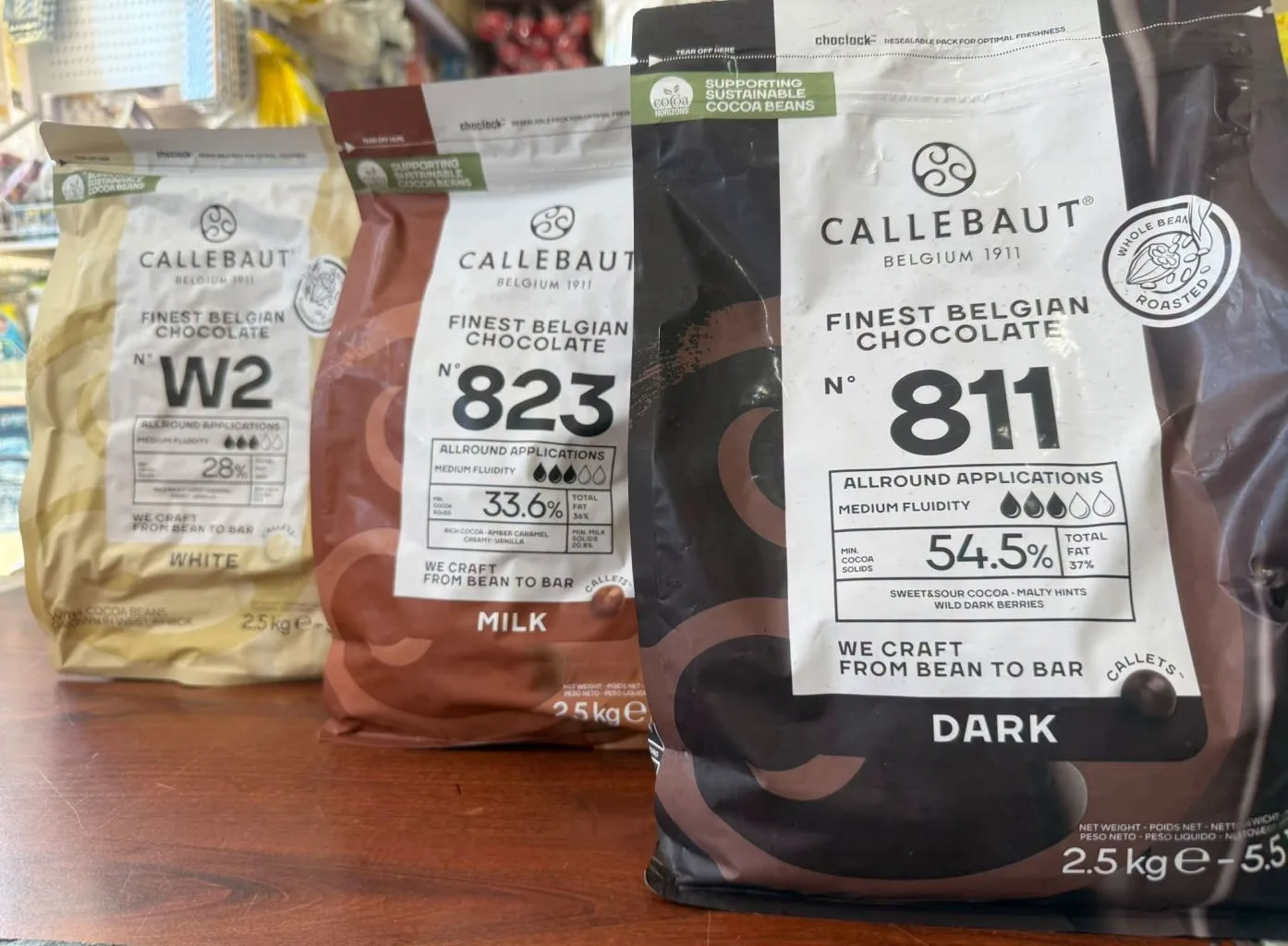
You can specify your required recipe, order volume and delivery destination so we can investigate an appropriate wholesale sourcing offer. Commercial sourcing is checked against your confirmed product specification, quantity and destination.
Choose Your Callebaut Chocolate: Dark 811, Milk 823 or White W2
Callebaut produces a versatile range of couverture Callets designed for consistent melting, dosing and crystallisation across culinary applications. Each core recipe features a distinct dry cocoa solids percentage, flavour profile and ingredient structure suited to specific confectionery, bakery and dessert preparations.
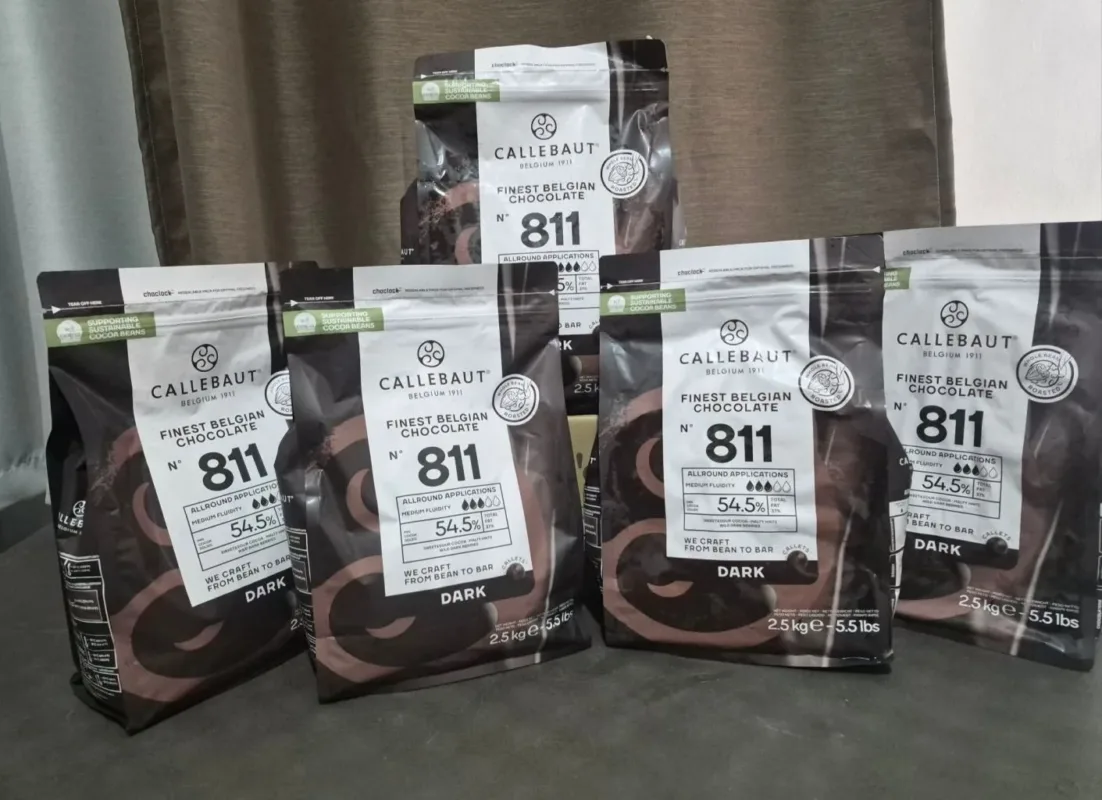
Callebaut 811 Dark Chocolate
Formulated with a published minimum of 54.5% dry cocoa solids, Recipe N°811 delivers a balanced roasted cocoa body with subtle fruity undertones. Standardised in 2.5kg professional bags under order code 811-E4-U71, it serves as an all-round dark couverture for ganache, moulding, enrobing and pastry work.
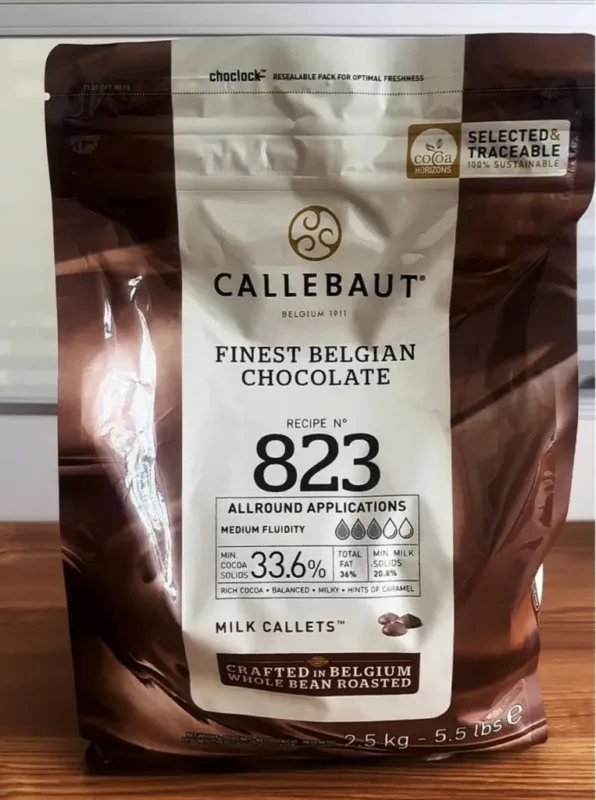
Callebaut 823 Milk Chocolate
Featuring a published 33.6% minimum dry cocoa solids content, Recipe N°823 provides a warm, creamy profile marked by milk, caramel and vanilla notes. Distributed in 2.5kg bags under reference 823-E4-U71, this formulation suits moulded confections, dessert fillings, mousse bases and bakery glazes.
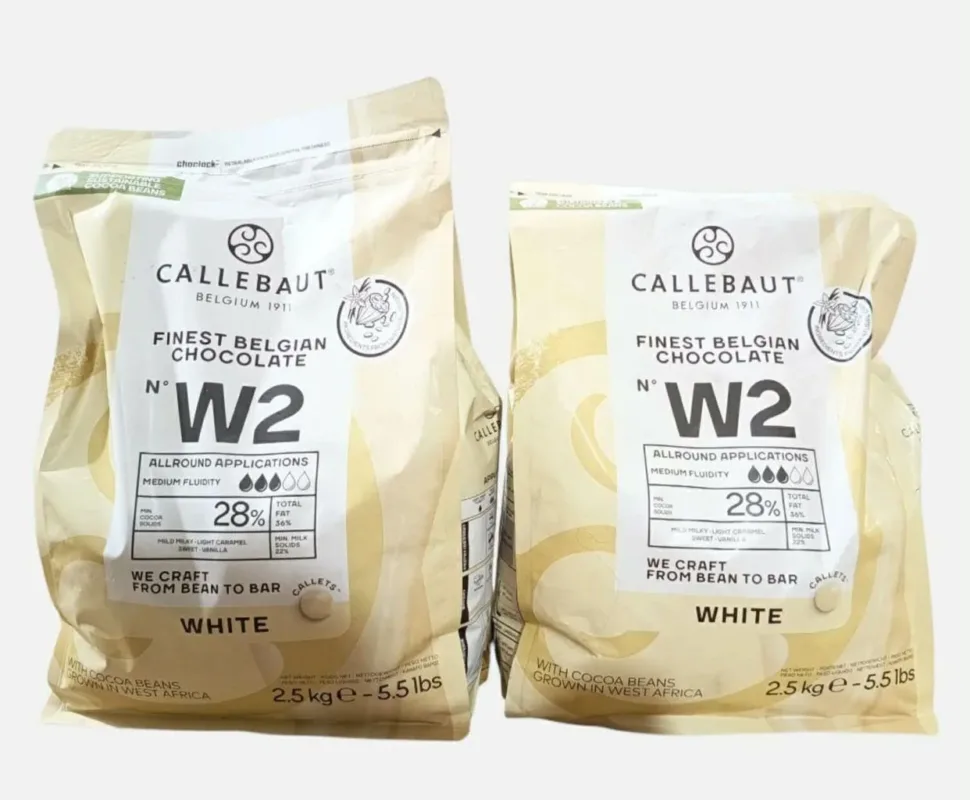
Callebaut W2 White Chocolate
Containing a published 28% minimum cocoa solids derived principally from cocoa butter, Recipe N°W2 offers pronounced milky, creamy sweetness with delicate natural vanilla. Packed under order code W2-E4-U71, it performs reliably in decorative piping, pralines, confectionery shells and bakery creams.
These three flagship recipes provide standard all-round fluidity suitable for most kitchen and production environments. Commercial buyers should select recipes based on precise recipe requirements, flavour balance and intended production methods. For technical handling guidelines across different recipe applications, review the official Callebaut FAQ.
How Professionals Work with Callebaut Callets
The Callet format eliminates the need to chop solid chocolate blocks, allowing uniform heat transfer during melting and consistent temperature control during tempering. Professional chocolatiers commonly employ the seeding method, adding un-melted drops to warm melted chocolate to establish stable beta cocoa butter crystals.
This demonstration illustrates general handling technique and does not represent a confirmation that every production lot behaves identically. Consult the official guide on tempering chocolate with Callets to verify recommended melting and working temperatures for your kitchen or production facility.
Callebaut 2.5kg Bags, Master Cases and Pallet Planning
Wholesale procurement requires an understanding of primary packaging units versus secondary transit cartons. Individual 2.5kg multi-layer bags protect the Callets from light and moisture, whilst outer corrugated cases group multiple bags for secure container and truck transport.
| Recipe | Published code | Professional bag | Bags per case | Net chocolate per case |
| 811 Dark | 811-E4-U71 | 2.5kg | 8 | 20kg net chocolate |
| 823 Milk | 823-E4-U71 | 2.5kg | 8 | 20kg net chocolate |
| W2 White | W2-E4-U71 | 2.5kg | 8 | 20kg net chocolate |
One published outer case contains 8 × 2.5kg bags = 20kg net chocolate. The numbers 811, 823 and W2 refer solely to chocolate recipe formulations, rather than case quantities or pallet structures.
These are published manufacturer packing examples. The actual supplied order code, outer-case GTIN, cases per pallet, pallet dimensions and batch specifications are confirmed for the sourcing offer.
Alternative packaging formats such as 1kg pouches, 5kg blocks or 10kg bulk bags represent distinct commercial items with separate packing rules. Buyers must not extrapolate 2.5kg case dimensions or pallet configurations to other product formats.
What to Check Before Ordering Callebaut in Bulk
Precise product specifications prevent delivery mismatches and customs rejections during international distribution. Distinct recipes carry specific order codes and Global Trade Item Numbers that must match your purchasing documentation exactly.
- Recipe differentiation: Identify exact recipe numbers, keeping standard 811 distinct from variants such as C811 or L811, and W2 separate from CW2 formulations.
- Manufacturer codes: Note the primary order reference, such as 811-E4-U71 or 823-E4-U71, alongside the individual bag GTIN and outer-case GTIN.
- Weight calculations: Distinguish net chocolate weight from gross shipping weight to calculate payload limits and road or container freight capacity accurately.
- Packaging units: State order volumes clearly in master cases or full pallet loads rather than unverified gross tonnage.
- Import compliance: Define destination labelling language, mandatory allergen declarations and minimum remaining shelf life requirements.
To request commercial sourcing, prepare an exact enquiry string such as: “Recipe 823 Milk, 2.5kg bags, published eight-bag / 20kg case format, required quantity stated in cases or pallets, destination and required label language.”
If your procurement schedule includes more than one recipe, provide the precise quantity needed for each line item. We evaluate multi-recipe sourcing requests as a consolidated order, but mixed pallets require supplier verification before commercial confirmation.
Where Callebaut Finest Belgian Chocolate Is Made
Callebaut produces its Finest Belgian Chocolate range at its historic facility in Wieze, Belgium, processing cocoa from whole roasted beans through to finished couverture Callets. The brand traces its chocolate-making heritage to 1911, establishing strict roasting and conching standards for professional chocolate confectionery.
Commercial buyers must keep manufacturing provenance distinct from intermediate trading operations. The European dispatch location of an independent sourcing supplier does not determine the underlying factory origin or batch certification of the chocolate.
You can review the background of Belgian chocolate production through the official Callebaut history documentation. Zeki Frucht operates as an independent sourcing specialist and does not manufacture chocolate, operate factory facilities or hold official distributor agreements.
Protecting Chocolate Quality During International Transport
Couverture chocolate contains cocoa butter that melts and destabilises when exposed to elevated temperatures or fluctuating humidity during transit. Exposure to heat causes fat bloom, leading to grey surface marbling and compromised crystal structure, whilst moisture causes sugar bloom and surface graining.
Callebaut recommends storing pure chocolate in clean, dry and odour-free environments within a temperature range of 12–18°C, with relative humidity kept below 70%. Follow the manufacturer guidelines on confectionery shelf life and good storage practices to protect product stability during warehousing.
CPT Terms
Carriage Paid To transfers transport risk once goods are handed to the first carrier, with carriage pre-arranged to your named destination.
CIF Shipping
Cost, Insurance and Freight covers maritime carriage and minimum marine cargo insurance to your designated destination sea port.
FOB Delivery
Free On Board requires the seller to clear goods for export and deliver them on board the vessel nominated by the buyer.
Specify shipping arrangements using standardised Incoterms rules to define risk transfer and transport obligations. Your local registered importer must confirm import licences, health declarations and labelling conformity before dispatch.
From Cocoa Beans to Callebaut Chocolate in Belgium
The manufacturing process behind Belgian chocolate involves sourcing selected cocoa beans, cleaning, whole-bean roasting, fine grinding, blending with cocoa butter and milk components, and extensive conching. These technical processing steps create the fine particle size and fluidity required for consistent commercial pastry production.
Manufacturer-published overview of the Callebaut Belgian chocolate-making process.
This footage outlines the manufacturer general chocolate production process at its Belgian plant. The video serves solely as technical background and does not verify the production date, packaging version, shelf life or export documentation of a specific future wholesale order.
Professional Chocolate Ingredients Versus Retail Chocolate Bars
Procurement teams must distinguish industrial and foodservice chocolate ingredients from consumer retail chocolate confectionery. Callebaut Callets represent bulk couverture chocolate formulated with high cocoa butter content for re-melting, enrobing, moulding and baking applications rather than immediate shelf consumption.
Do not order professional couverture Callets for direct retail snack distribution. Couverture packaging features commercial handling data, industrial barcodes and culinary instructions tailored to commercial kitchens rather than end-consumer retail displays.
If your purchasing requirements include pre-packaged retail confectionery rather than culinary couverture, order wholesale chocolate bars under separate commercial freight arrangements. Buyers evaluating consumer confectionery pack configurations can review our Mars chocolate wholesale packaging guide to compare count sizes and master carton specifications.
Callebaut Wholesale Questions
Can commercial buyers request Callebaut 811, 823 and W2 together?
Yes, buyers can combine Callebaut 811, 823 and W2 within a single wholesale sourcing enquiry. Consolidated supply depends on current supplier allocation, lot availability and agreed freight handling arrangements for your target delivery port.
How many 2.5kg bags are in a published master case?
A standard published master case contains eight 2.5kg bags, providing 20kg net chocolate weight across the 811, 823 and W2 product lines. Specifications should be cross-referenced against the relevant Callebaut product documentation.
How many Callebaut cases fit on one pallet?
Total cases per pallet depend on the specific pallet type, carrier height limits and regional packaging formats used by the dispatching supplier. We verify exact case counts, layer patterns and gross pallet weights when preparing your commercial quotation.
Is Callebaut chocolate manufactured in Belgium?
Callebaut states that its Finest Belgian Chocolate range is produced from bean to bar in Wieze, Belgium. Each commercial shipment is verified against official manufacturer documentation and export health paperwork for the specific supplied batch.
What information is needed for a wholesale quotation?
To request a formal quotation, state your required recipe, manufacturer product code if known, total volume in cases or pallets, destination port, label language and preferred delivery terms. We review these parameters to confirm pricing and logistics.
Request a Callebaut Wholesale Sourcing Quote
To receive a verified commercial quotation, submit your required Callebaut recipe, pack size, order volume in cases or full pallets, target delivery destination, label language requirements and preferred Incoterms. We assess supplier availability, shipping routes and batch specifications to prepare a formal trade quotation.
Submit Commercial Sourcing Requirements
Provide exact product codes, order volumes and delivery ports to receive a formal quotation for international shipment.