

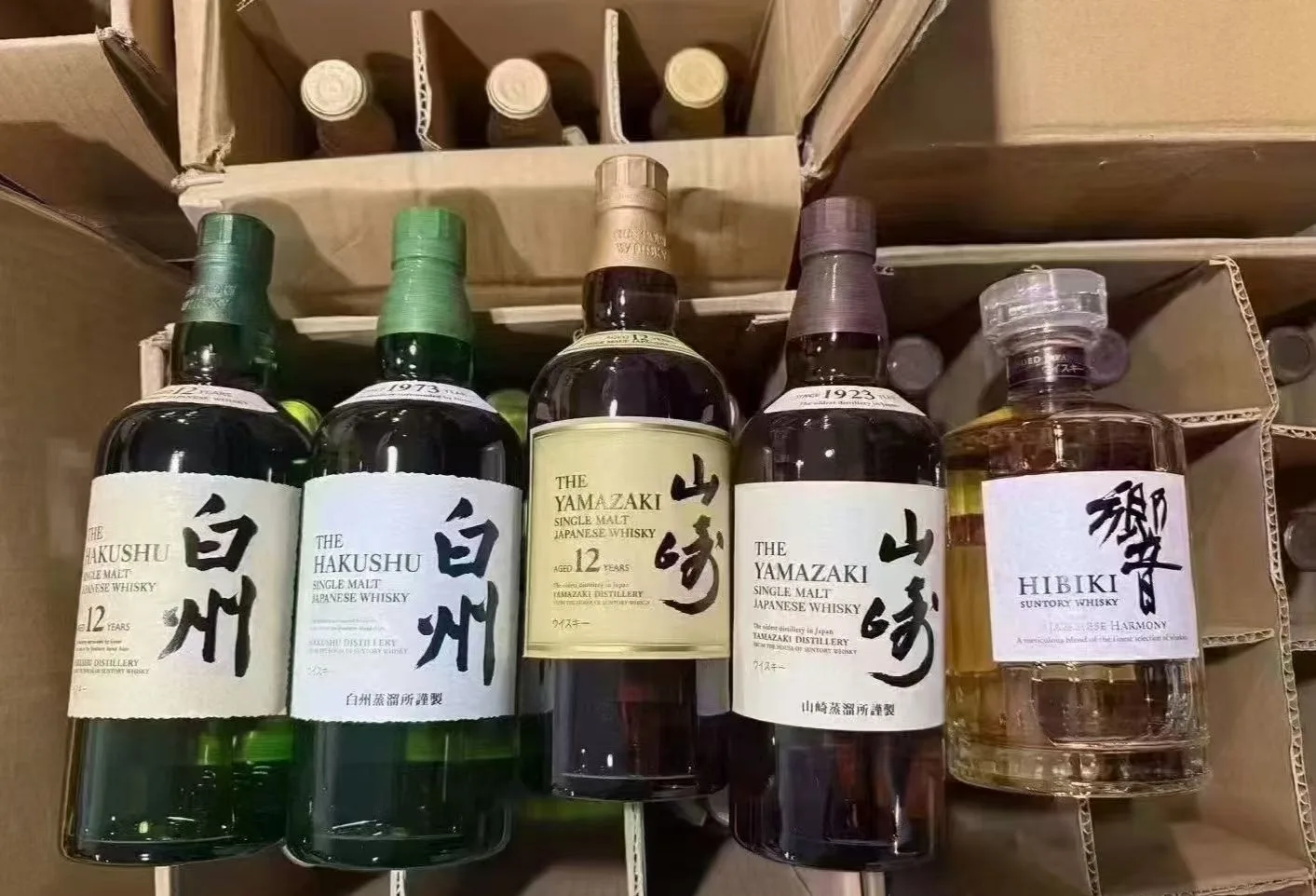
Zeki Frucht GmbH operates as an independent international B2B sourcing company handling qualified commercial inquiries for authentic Japanese whisky wholesale distribution. Importers, regional distributors, and hospitality procurement groups source verified allocations across Suntory’s three signature labels: Hibiki, Yamazaki, and Hakushu. Supply arrangements evaluate standard releases, established age-stated bottlings, and confirmed limited editions based on current trade availability.
Commercial quotations depend on exact technical specifications rather than generic brand requests. Buyers must define the target expression, bottle format, commercial volume, destination port, and delivery terms to initiate availability checks. We evaluate inventory across established supplier channels to structure accurate, contract-backed commercial shipments.
Hibiki, Yamazaki and Hakushu: Understanding the Differences
Evaluating Suntory’s portfolio requires a strict commercial distinction between blended Japanese whisky and single malt expressions. Each product line originates from distinct production facilities and serves specific commercial market segments across Asia.
Hibiki Blended Whisky
Hibiki represents Suntory’s blended Japanese whisky portfolio, combining malt whiskies from Yamazaki and Hakushu with grain whisky from the Chita distillery. The range spans no-age-statement Japanese Harmony up to prestigious age-stated editions.
Yamazaki Single Malt
Produced at Japan’s pioneer malt distillery founded in 1923, Yamazaki delivers a complex, fruit-forward profile shaped by diverse cask types, including American white oak, Spanish sherry wood, and rare Japanese Mizunara oak.
Hakushu Single Malt
Crafted at Suntory’s mountain forest distillery, Hakushu features crisp herbal, green-fruit, and delicate peated notes. Its Distiller’s Reserve and age-stated releases represent a distinctly fresh single malt profile.
Commercial buyers must differentiate these families when planning catalog positioning and retail allocations. Blended whiskies like Hibiki address balanced luxury consumption, whereas single malts target connoisseur retail and dedicated on-premise accounts.
| Whisky family | Whisky category | Production relationship | Main expressions | Commercial buying considerations |
| Hibiki | Blended whisky | Malt and grain blend | Harmony, 21, 30 YO | High global gifting demand and steady luxury banquet consumption. |
| Yamazaki | Single malt | Yamazaki Distillery | Reserve, 12, 18, 25 YO | Core collector focus with distinct secondary-market liquidity. |
| Hakushu | Single malt | Hakushu Distillery | Reserve, 12, 18, 25 YO | Strong demand among premium cocktail bars and specialty whisky retailers. |
For verified brand specifications, importers can consult the official manufacturer resources for Hibiki, Yamazaki, and Hakushu.
Hibiki Whisky and Japanese Craftsmanship
The House of Suntory produces dedicated brand documentaries illustrating the heritage, cooperage, and artisanal elements behind its flagship blended expressions. These materials demonstrate the production complexity associated with Hibiki’s multi-cask integration and presentation standards.
Official House of Suntory film exploring the Japanese craftsmanship associated with Hibiki.
This brand film provides commercial buyers with context on the materials and labor required to produce Hibiki packaging and blending components. It does not represent commercial inventory or an exclusive supplier partnership between Zeki Frucht GmbH and the manufacturer.
Hibiki Wholesale: Japanese Harmony, 21 and 30 Years Old
Commercial sourcing of Hibiki centers on three primary expressions, each carrying distinct packaging variations, regulatory labels, and market allocations. Verifying the exact target edition avoids inventory mismatches during customs clearance.
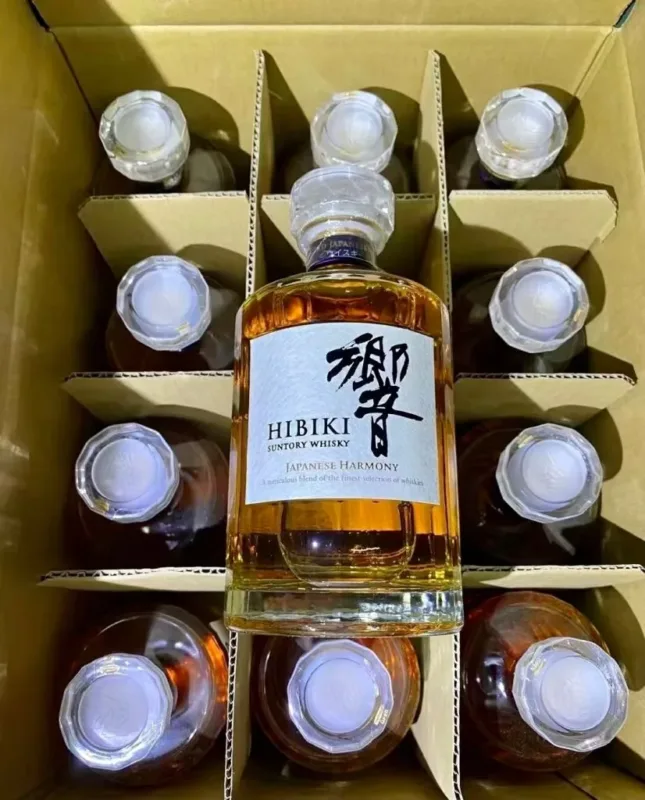
Hibiki Japanese Harmony operates as the core volume line within the blended portfolio. As a no-age-statement bottling, it requires verification of destination-market labeling, including domestic Japanese releases versus export-compliant packaging formats. Its signature 24-faceted bottle represents the 24 seasons of the Japanese lunar calendar.
Hibiki 21 Years Old represents a premium tier built on mature malt whiskies and grain spirits aged over two decades. Commercial inquiries must define whether presentation gift boxes are required, as secondary market values and retail presentation vary significantly between boxed and unboxed stock.
Hibiki 30 Years Old is an ultra-aged release produced in limited quantities each year. Procuring this expression requires rigorous provenance verification, bottle seal inspections, and confirmed supplier allocation checks prior to quotation agreement.
Occasional limited editions, such as Hibiki Blossom Harmony or master’s selects, appear within commercial trading channels. We evaluate these items strictly on a lot-by-lot basis against confirmed buyer purchase orders.
Yamazaki Single Malt: Distiller’s Reserve, 12, 18 and 25 Years Old
The Yamazaki range commands high liquidity among Asian spirits wholesalers, requiring precise identification of age statements and packaging configurations. Each age tier functions as a completely independent SKU with distinct supply dynamics.
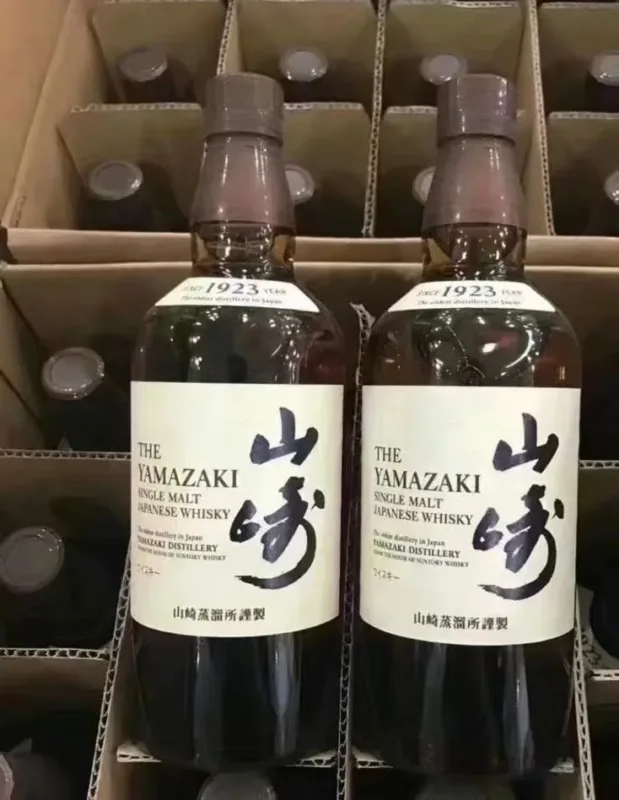
Yamazaki Distiller’s Reserve functions as the entry single malt, blended from varied cask types without an age statement to maintain flavor consistency. It provides high turnover for hospitality accounts and retail programs across regional distribution hubs.
Yamazaki 12 Years Old serves as the standard commercial benchmark for Japanese single malt. Maturation across American oak, Spanish oak, and Japanese Mizunara wood creates high commercial demand that requires planned ordering cycles.
- Yamazaki 18 Years Old: Matured predominantly in Spanish sherry casks, this age-stated bottling represents a luxury hospitality staple requiring verified carton and box integrity.
- Yamazaki 25 Years Old: An ultra-aged expression featuring mature sherry wood components, allocated under strict annual quotas and quoted only upon verified buyer demand.
- Special Cask Releases: Editions finished purely in Mizunara, Peated Malt, or Sherry Cask are unique SKUs that must never be substituted for core age-stated lines.
Wholesale inquiries must state whether individual gift cartons are mandatory, as export cases occasionally circulate in trade-pack formats without retail boxes.
Hakushu Single Malt: Distiller’s Reserve, 12, 18 and 25 Years Old
Hakushu offers commercial buyers a contrasting profile to Yamazaki, characterized by crisp, herbaceous notes and gentle peat smoke derived from its mountain location. Demand has accelerated steadily across Asian high-end dining and cocktail venues.
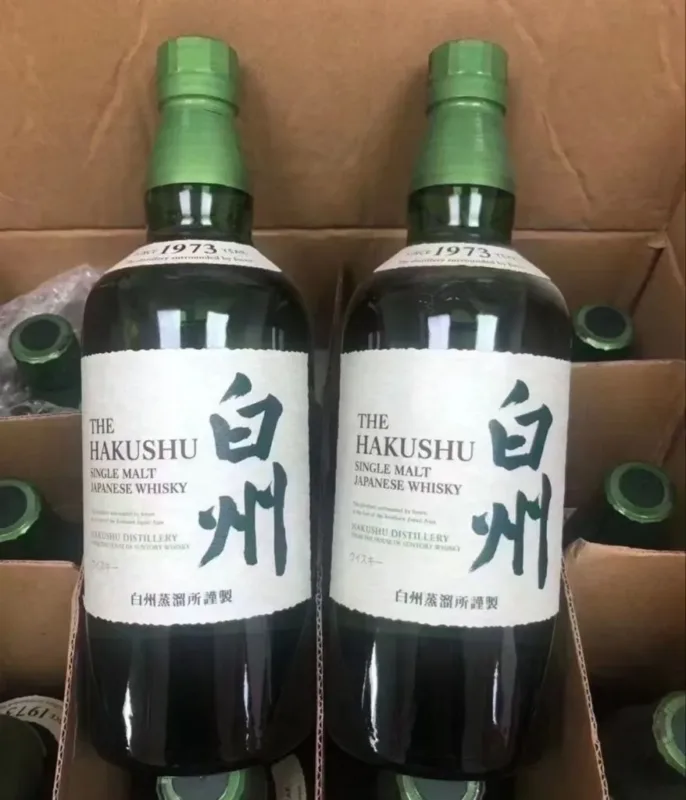
Hakushu Distiller’s Reserve provides approachable single malt volume, utilizing lightly peated malts blended with mature components. It serves distributors supplying premier hotel bars and casual luxury dining groups.
Hakushu 12 Years Old delivers structured herbal complexity, green apple notes, and delicate campfire smokiness. It remains a core procurement objective for licensed spirits distributors seeking stable premium malt inventory.
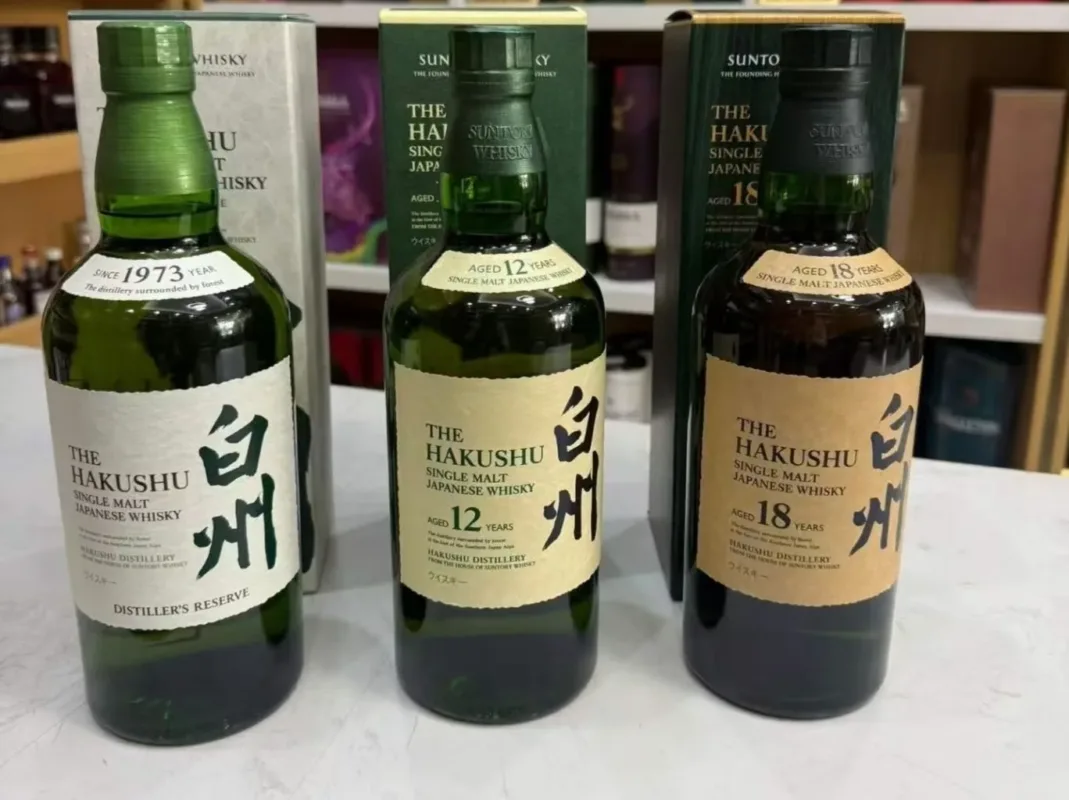
Hakushu 18 Years Old and 25 Years Old operate under tightly controlled trade allocations. Importers must not assume permanent supplier inventory for these high-value lines; each quotation requires live verification of batch availability.
Specialty editions, such as Hakushu Peated Malt or anniversary bottlings, are evaluated individually. Commercial pricing and transit lead times reflect the rarity and market location of confirmed lots.
Age Statements, Limited Editions and Presentation Packaging
Commercial precision requires treating every variation in age statement, packaging, and vintage release as an entirely separate trade item. In bulk spirits procurement, substituting one edition for another creates commercial dispute and customs rejection.
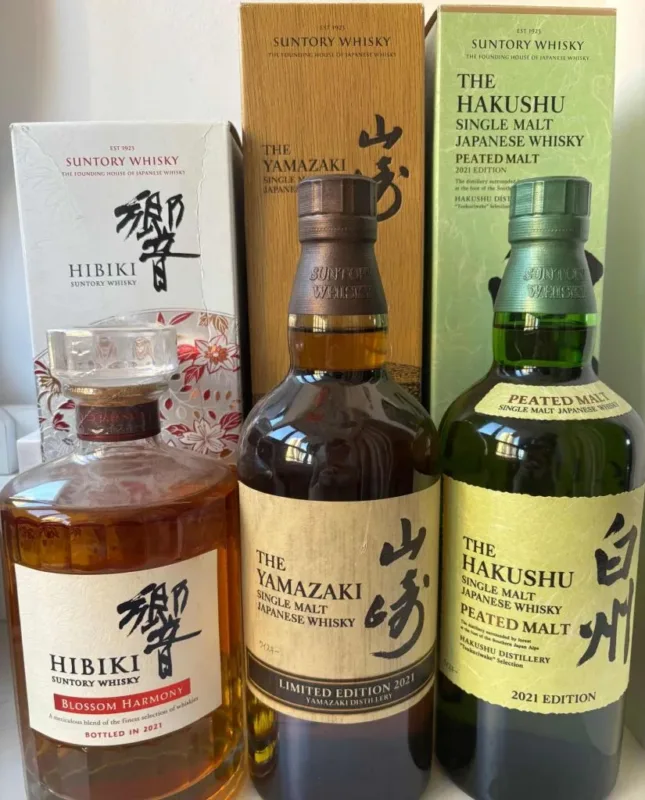
A request for Hibiki Japanese Harmony cannot be fulfilled with age-stated stock, nor can an inquiry for Yamazaki 18 Years Old be substituted with standard Yamazaki 12 or unboxed trade variants. Similarly, Hakushu Distiller’s Reserve does not replace Hakushu 12 in tender contracts.
Presentation boxes represent a substantial portion of resale value in Asian retail and duty-free channels. Importers must specify whether secondary packaging, outer display boxes, or naked bottles are required for their target distribution channel.
Historical collector editions, such as Hibiki Blossom Harmony 2021, Yamazaki Limited Edition 2021, or Hakushu Peated Malt 2021, circulate primarily through secondary trade channels. These historical bottlings do not represent recurring current-year distillery allocations.
Limited-edition bottlings require individual provenance documentation, batch verification, and packaging inspection prior to order confirmation. Availability changes rapidly based on spot-market liquidity.
Confirming the exact release year, barcode (GTIN), and packaging design ensures that all commercial parties evaluate identical inventory parameters.
Japanese Whisky Wholesale Bottle, Case and Pallet Specifications
Professional spirits logistics require exact data on packaging hierarchy: individual bottles, gift cartons, corrugated master shipping cases, and secured pallet loads. Wholesale buyers must base freight calculations on confirmed packing sheets rather than theoretical estimates.
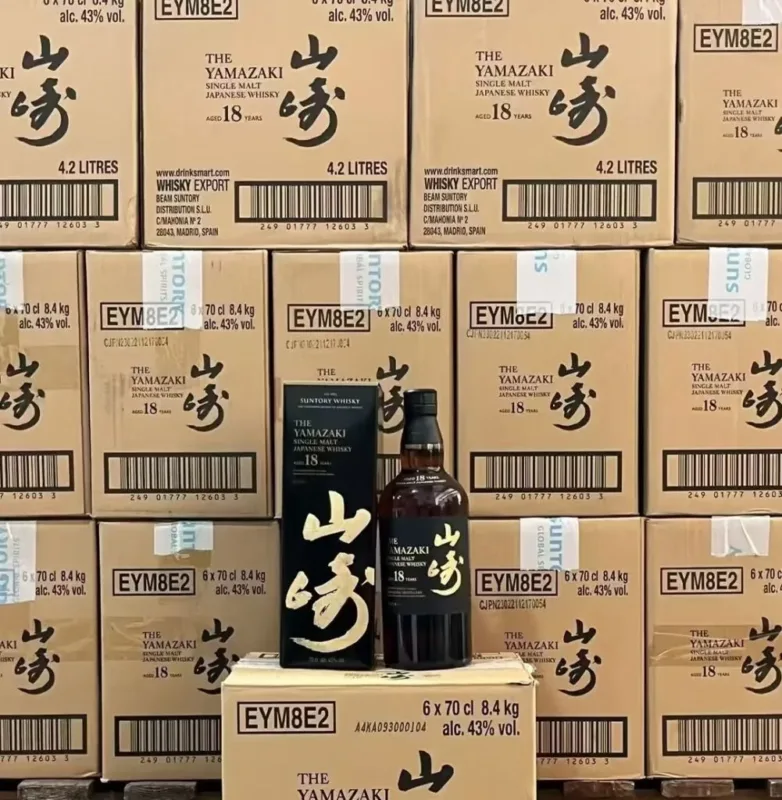
Standard export bottle capacities for the Asian market center on the 700 ml format. Verified commercial trade channels commonly package Hibiki Japanese Harmony, Yamazaki 12, and Hakushu 12 in six-bottle corrugated master cases.
A standard six-bottle case containing 700 ml bottles has a net liquid capacity calculated as follows: 6 x 700 ml = 4.2 litres. This net liquid arithmetic does not establish gross case weight or pallet configuration, which depend on glass thickness, carton density, and packaging design.
| Expression | Bottle-size example | Published case example where verified | Gift-box considerations | Pallet specification to confirm |
| Hibiki Harmony | 700 ml | 6 bottles per case | Available with or without individual carton. | Confirm cases per layer and total pallet height. |
| Yamazaki 12 YO | 700 ml | 6 bottles per case | Branded gift cartons standard for retail lines. | Obtain supplier packing sheet for gross weight. |
| Hakushu 12 YO | 700 ml | 6 bottles per case | Gift carton included on standard retail SKUs. | Verify stackability and pallet wrap standards. |
| Yamazaki 18 YO | 700 ml | Case format varies | Heavy presentation box changes carton volume. | Requires specific lot packing slip before loading. |
| Hibiki 21 YO | 700 ml | Case format varies | Rigid presentation case alters master dimensions. | Pallet configuration determined by case size. |
Pallet configurations vary significantly depending on the supplier’s warehouse handling rules, shipping mode, and dispatch location. Importers should review this technical checklist when submitting formal tenders:
- Exact commercial product name and registered age statement.
- Specific release vintage or batch identifier.
- Bottle volume in milliliters and alcohol by volume percentage.
- Bottle barcode (EAN/GTIN) and master carton code.
- Number of bottles packed per master shipping carton.
- Inclusion and condition of individual presentation boxes.
- Master case exterior dimensions and gross case weight.
- Pallet layering structure, total pallet weight, and batch documentation.
Where technical packing dimensions are not published in advance, we verify them directly with the holding warehouse prior to booking international transport.
Whisky Packaging, Storage and International Shipping Preparation
High-value distilled spirits demand strict physical care during storage and cross-border transport. Professional distributors evaluate cargo condition based on seal integrity, label cleanliness, and the structural soundness of master cartons.
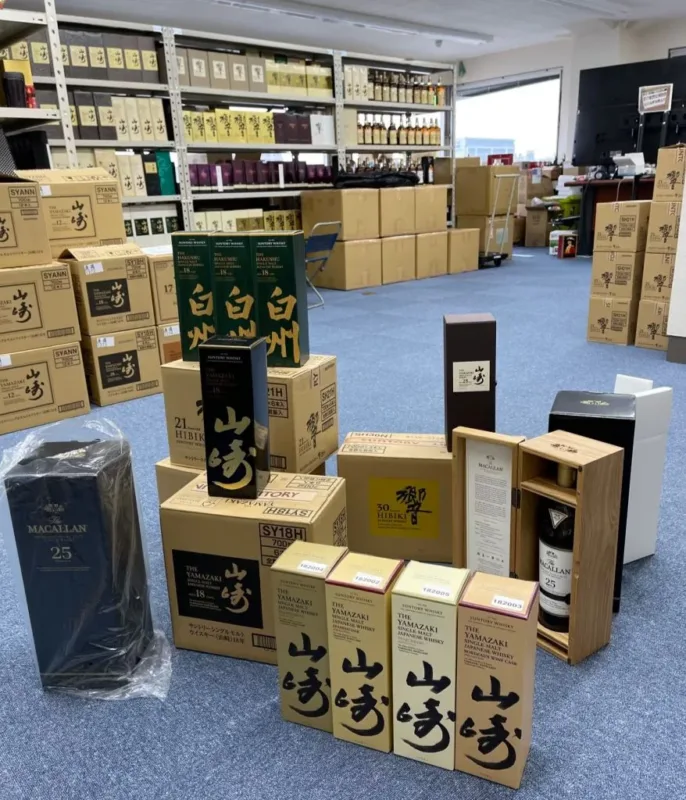
Illustrative commercial whisky assortment and shipping-carton presentation. Not confirmed Zeki Frucht-owned inventory.
Spirits warehousing requires dry, temperature-regulated facilities protected from direct ultraviolet light. Prolonged exposure to extreme heat during transit can compromise capsule seals, cause ullage variations, and degrade external label adhesive.
Securing palletized cargo with reinforced edge protectors, moisture-resistant plastic stretch film, and security tape reduces the risk of physical abrasion and packaging damage during multi-modal transit.
Importers must inspect cargo immediately upon container destuffing, comparing outer carton batch markings against commercial packing lists to ensure complete shipment traceability.
Verifying Genuine Hibiki, Yamazaki and Hakushu for Wholesale Trade
The global reputation of Japanese whisky requires professional buyers to conduct systematic product verification. Importers must rely on documented supply chains, legitimate tax documentation, and authentic packaging characteristics rather than informal assurances.
The Japan Spirits & Liqueurs Makers Association established labeling standards defining authentic Japanese whisky, requiring domestic fermentation, distillation, and aging in wooden casks in Japan. The House of Suntory publishes clear product classifications addressing these standards across their product documentation.
Commercial dispatch location must not be confused with manufacturing origin. Genuine Suntory whisky sourced through established commercial trading partners in Germany remains authentic Japanese whisky manufactured in Japan, regardless of European dispatch.
A barcode prefix does not serve as standalone legal proof of production authenticity. Licensed distributors verify commercial legitimacy by matching master carton batch codes, bottle laser etching, export declaration papers, and formal commercial invoices.
Japanese Whisky Wholesale Opportunities Across Asia
Asia represents the primary consumer and trading hub for high-end Japanese spirits, characterized by sophisticated retail networks, established duty-free operations, and high-volume corporate entertainment sectors.
Singapore & Hong Kong
These established trading hubs serve as primary regional transit, bonded warehousing, and re-export centers, requiring efficient customs processing and flexible pallet storage.
Taiwan & South Korea
Mature single malt markets with high retail literacy, demanding consistent allocations of age-stated Yamazaki and Hakushu alongside premium luxury gift packaging.
Distributors in these regional markets require disciplined supplier communication regarding real trade allocations. Reviewing broader portfolio categories, such as Alcoholic Drinks, helps commercial buyers balance high-demand Japanese allocations with supplementary commercial spirits lines.
Import compliance across Asian jurisdictions demands strict adherence to local spirit taxation, health warning labels, and customs registration rules prior to port dispatch.
How Yamazaki, Hakushu and Hibiki Are Produced
Understanding Suntory’s production architecture clarifies why allocations remain tightly regulated across global commercial channels. The manufacturer operates distinct malt production facilities while centralizing its blending operations.
- Yamazaki Distillery (Est. 1923): Located in the misty vale of Yamazaki, this facility utilizes multiple pot still shapes and varied wooden washbacks to produce diverse malt profiles.
- Hakushu Distillery (Est. 1973): Situated in the forests of Mount Kaikoma, Hakushu utilizes pristine mountain water and varying peat levels to craft light, herbal single malt whiskies.
- Master Blending Integration: Hibiki relies on the expertise of Suntory’s blending team, uniting mature Yamazaki and Hakushu malts with clean grain whisky produced at the Chita distillery.
Because aging in Japanese white oak, Spanish sherry wood, and Mizunara oak requires decades of maturation, output cannot be accelerated on short notice. Wholesale allocations reflect long-term cask inventory rather than short-term consumer demand.
Buyers consolidating beverage inventory across multiple branded segments can evaluate Our Products to coordinate commercial supply across parallel categories.
Suntory Whisky Craftsmanship at Hakushu Distillery
Production heritage and environmental conditions heavily influence single malt output, as shown in official manufacturer materials documenting operations at Hakushu’s mountain location.
Official Suntory craftsmanship film exploring whisky-making traditions at Hakushu Distillery.
This historical documentary demonstrates the environmental and technical rigor underpinning Hakushu single malt production. It provides technical appreciation for Suntory’s methods without implying direct distillery export contracts or proprietary factory representation.
Sourcing Japanese Whisky Through Japan and German Trading Channels
Zeki Frucht GmbH evaluates international procurement pathways to satisfy commercial orders from licensed Asian buyers. Sourcing routes incorporate verified trade channels in Japan as well as established commercial distribution partners in Germany and wider Europe.
- Direct factory and domestic distributor supply routes.
- Domestic Japanese labeling formats and EAN specifications.
- Subject to domestic release schedules and export quotas.
Sourcing Direct from Japan
- Established European commercial inventories and bonded stock.
- Multilingual international packaging compliant with trade rules.
- Potential consolidation with broader European luxury spirits.
Sourcing Through Germany
Sourcing feasibility depends on the requested expression, target volume, and commercial conditions. We conduct thorough due diligence on supplier credentials, export licenses, batch documentation, and dispatch readiness before issuing a formal commercial offer.
Rare expressions such as Hibiki 30, Yamazaki 25, or Hakushu 25 require case-by-case sourcing reviews. We do not claim permanent, unlimited stock availability for ultra-aged lines.
Planning Japanese Whisky Shipments to Asian Importers
Executing cross-border liquor shipments requires thorough documentation and clear international commercial terms. Proper operational planning avoids customs delays and protects cargo value throughout the transport chain.
Standard documentation prepared for wholesale spirits export includes the commercial invoice, packing list, certificate of origin, transit insurance certificates, and ocean bills of lading or air waybills. Every document must align perfectly with the buyer’s local import permit requirements.
Selecting appropriate delivery terms is critical. CIF (Cost, Insurance, and Freight) to a named Asian port is widely utilized for ocean transport. When goods are handed to a freight forwarder prior to vessel loading, FCA (Free Carrier) is often more appropriate than FOB under the Incoterms Rules.
Commercial buyers seeking comprehensive international freight planning can review operational frameworks on Wholesale Premium Spirits to streamline documentation workflows.
Request a Hibiki, Yamazaki and Hakushu Wholesale Quote
Zeki Frucht GmbH provides structured sourcing solutions for licensed importers, wholesale merchants, and duty-free purchasing offices. When you submit a commercial inquiry, we assess live availability across our international trade network, confirm packaging configurations, and deliver a combined quotation.
To receive an accurate and timely commercial proposal, please include the following technical specifications in your initial inquiry:
- Registered company name, tax registration number, and corporate website.
- Specific whisky brand, expression name, and age statement.
- Target bottle format (e.g., 700 ml) and requested case quantities.
- Packaging preferences, including individual presentation box requirements.
- Target destination country and named discharge port or bonded warehouse.
- Preferred Incoterm (e.g., CIF Singapore, FCA Hamburg) and required delivery schedule.
Submit Commercial Sourcing Specifications
Provide your specific Japanese whisky product requirements, volume targets, and preferred delivery terms to receive a contract-backed sourcing quotation.
Frequently Asked Questions
Can Hibiki, Yamazaki and Hakushu be included in one sourcing enquiry?
Yes, buyers can combine inquiries for Hibiki, Yamazaki, and Hakushu into a single sourcing request. We evaluate multi-brand availability across verified supplier channels to prepare one unified commercial quotation when sourcing conditions allow.
What is the difference between Hibiki blended Japanese whisky and Yamazaki or Hakushu single malt?
Hibiki is a blended Japanese whisky combining mature malt whiskies from Yamazaki and Hakushu distilleries with grain whisky from Chita. In contrast, Yamazaki and Hakushu are single malt whiskies produced entirely from malted barley at their respective standalone distilleries.
Are all Suntory whisky expressions available in six-bottle shipping cases?
No, shipping case configurations vary depending on the specific expression, age statement, and target distribution market. While standard 700 ml bottles of Hibiki Harmony, Yamazaki 12, and Hakushu 12 commonly pack in six-bottle master cartons, higher-aged and special editions may utilize different case sizes.
Can importers request Hibiki 21 or 30, Yamazaki 18 or 25, and Hakushu 18 or 25?
Yes, licensed importers may request quotations for ultra-aged and prestige expressions. Because these high-value lines operate under tight global allocations, availability and lead times are verified individually for each commercial order.
Can Japanese whisky be sourced through suppliers in Germany and Japan?
Yes, genuine Suntory whisky is commercially evaluated through established distribution channels in both Japan and Germany. Sourcing genuine Japanese whisky through European trading partners provides access to export-ready bonded inventory while maintaining original Japanese manufacturing origin.
What information should an Asian whisky importer provide to receive a quotation?
Importers should specify the exact whisky expressions, age statements, bottle sizes, carton packaging requirements, order quantities, named destination port, and preferred Incoterm. Providing complete technical details allows our team to issue an accurate, actionable commercial offer.
Next Steps for Commercial Japanese Whisky Procurement
Securing genuine Suntory Japanese whisky wholesale allocations requires verified commercial channels, rigorous technical specifications, and transparent logistics documentation. Licensed importers and regional beverage distributors establish predictable supply chains by working with an independent sourcing partner dedicated to order-specific availability checks and contract compliance.